

iHuman case study answers 2026 – Everything you need to know
Need iHuman case study answers in 2026? Discover common myths and how expert iHuman support helps nursing students.
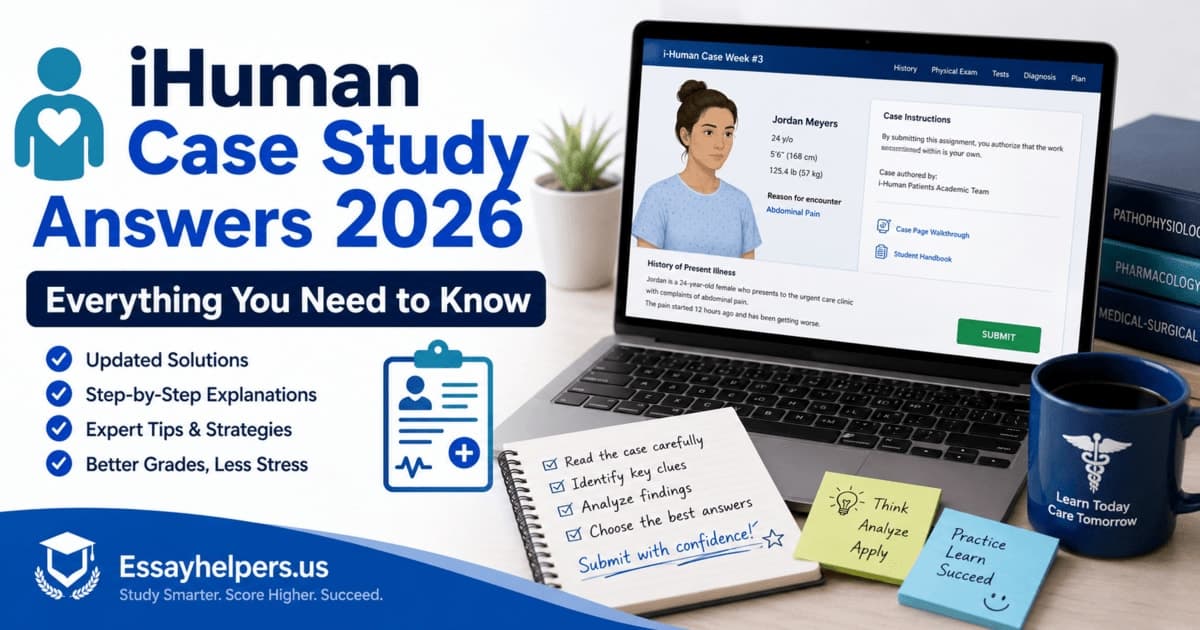
You already know what iHuman case study answers 2026 looks like as a search query. You typed it — maybe at midnight, maybe with two other assignments open in the background. The pressure was real, the deadline was close, and the internet looked like a shortcut.
The problem is that most of what you find when you search for iHuman answers is built to look helpful without actually being reliable. Quizlet decks, flashcard forums, third-party answer sites — they get high traffic, they look authoritative, and they fail nursing students at a consistent rate. iHuman case studies are among the most challenging assignments in any nursing program, and searching for iHuman case study answers online is one of the most common mistakes students make in the weeks before a clinical exam.
This post breaks down the four biggest myths nursing students believe about finding iHuman case study answers 2026 — and replaces each one with what actually works. Whether you are on Kaplan, Walden University, or any other nursing program that uses the platform, the same rules apply to your case. By the end of this post, you will know exactly what the iHuman grading rubric rewards, why most iHuman case study answers 2026 found online fall short, and what legitimate iHuman case study help online actually delivers. The iHuman case study answers for nursing students that produce results are not the ones on Quizlet. They are the ones built on clinical reasoning — and this post will show you why that distinction matters every time you open a new iHuman case study answers 2026 assignment.
What is iHuman and why nursing students find it so hard
When nursing students ask what is iHuman nursing, they usually ask before their first case. After the second assignment, the question changes. It becomes: why is this platform harder than everything else on my program?
iHuman is a virtual patient simulation platform. It places you in a clinical encounter with a computer-generated patient and expects you to take a full history, conduct a physical examination, build a differential diagnosis, and write a complete SOAP note. There is no textbook open. There is no guessing strategy. The system records and scores every clinical decision you make throughout the case.
The iHuman virtual patient simulation is designed to mirror real-world clinical encounters. The patient responds based on the questions you ask. If you rush through the iHuman history taking section, you miss findings that change the entire diagnostic picture. Those missed findings feed directly into your grade.
This is exactly why searching for iHuman case study answers 2026 feels urgent to so many students. The stakes are high and the time pressure is real. But the iHuman grading rubric does not score the way most students expect. It doesn't just reward the correct final diagnosis. It rewards the clinical reasoning path that gets you there — every question asked, every finding recorded, every diagnosis justified with case evidence. That is the gap where every iHuman case study answers shortcut eventually collapses.
Understanding what the platform actually measures is the first step toward iHuman nursing exam prep 2026 that works. And once you understand it, the limitations of every iHuman case study answers 2026 shortcut become obvious — because no answer list can replicate a reasoning process.
Myth 1 — you can find working iHuman answers on Quizlet
This is the most popular myth by a wide margin. A student searches for iHuman case study answers quizlet and finds dozens of decks with thousands of views, carefully formatted and confidently labeled. They look like the answer. They're not.
Here is what actually happens when you rely on iHuman answers quizlet for your case.
The decks are program-specific snapshots from a different time. The iHuman answers found in a deck created by a Kaplan student in 2023 reflect their version of the case, scored against their faculty's rubric. Your version of the same case in 2026 may have different question weighting, different history section depth requirements, and different SOAP note formatting expectations. The iHuman case study answers 2026 you find in a three-year-old Quizlet deck are answers for someone else's assignment.
iHuman questions flashcards built on older case content become unreliable the moment the platform refreshes that case. iHuman updates its content on a rolling cycle. Answers to iHuman cases posted before the current academic year may not match a single scored section in your current assignment. You could memorise the entire deck and still fail.
There is also a deeper structural problem. Even if the deck were perfectly accurate, it gives you the destination without the journey. The iHuman case study answers 2026 that earn marks are the ones supported by a visible reasoning trail — the questions asked, the findings recorded, the diagnoses logically justified with clinical evidence from the case. A Quizlet card tells you what was right for someone else's submission. It cannot show you why — and why is exactly what the iHuman grading rubric scores.
iHuman clinical exam preparation requires building that reasoning process from the case data in front of you. No flashcard deck contains that. Searching for iHuman case study answers 2026 on Quizlet is not a shortcut — it is a detour that wastes the time you need most. Every minute spent chasing outdated iHuman case study answers is a minute not spent on the clinical thinking the rubric actually rewards.
Enhance your Academic Performance And Reach Your Goals
See how quick and easy it is to get an exceptional essay with minimal effort on our platform
Myth 2 — named case answers are the same for everyone
Students searching for david douglas iHuman answers, jake mason iHuman answers, and robert jones iHuman answers often assume that named patient cases have fixed, universal answers. Someone already posted the solution. It must apply to every student who gets that case.
This assumption is wrong — and it leads to failed submissions regularly.
Named iHuman cases are not standardised across every program. The Rebecca Fields iHuman case study presents the same patient and the same chief complaint at two different universities. But the rubric weighting, the expected depth of the history section, the number of differential diagnoses required, and the SOAP note format standards are set by faculty at each program — not by iHuman's platform itself.
The Krista Hampton iHuman case study answer that earns 88% at one university may earn 60% at another because the scoring checkpoints differ. Amanda Wheaton iHuman answers and laura wood iHuman answers carry the same risk. What worked for the student who posted their solution reflects the requirements of their specific program at the time they submitted it. Those requirements are not yours.
Anselmo lopez iHuman answers follow the same pattern. The patient scenario looks identical from the outside. The grading logic underneath it is completely different depending on where you are studying.
The core error behind the iHuman case study answers 2026 myth is the belief that one correct answer set covers every student on every program. iHuman case study answers for nursing students are only valuable when they match the specific rubric and expectations of the program submitting them. iHuman case study answers 2026 found on generic answer-sharing sites match no program's rubric with any reliability, because they were never designed to. Before you use any iHuman answers from a third-party source, ask: were these written for my program's rubric? The answer is always no.
Myth 3 — iHuman Kaplan answers and Walden University answers are interchangeable
This is a more specific version of Myth 2, and it deserves its own section because Kaplan and Walden University are the two most heavily searched program names attached to iHuman case answers online.
Students searching for iHuman Kaplan answers 2026 and iHuman Walden University answers frequently land on pages that list both program names above a single answer set, as though the two programs use the same grading framework. They don't.
Kaplan iHuman case study answers are built around Kaplan's nursing education structure. The iHuman clinical exam preparation requirements at Kaplan weight history-taking depth heavily in the rubric. The iHuman SOAP note at Kaplan follows a specific format that faculty grade against section by section. Getting the diagnosis right but formatting the SOAP note incorrectly loses marks in ways the generic answer sites never flag.
Walden University uses the same iHuman virtual patient simulation platform but applies different performance benchmarks and different scoring weights to each case component. The iHuman Walden University answers that score at distinction level at Walden may miss critical Kaplan criteria entirely — because the programs prioritise different clinical reasoning demonstrations.
The iHuman SOAP note is the most common failure point in this situation. A student who sources iHuman case study answers 2026 from the wrong program ends up with a SOAP note structured for a different faculty's expectations. The clinical content may be correct. The format costs marks anyway.
iHuman case study answers 2026 need to be program-specific. That is not a minor detail. It is the detail that determines whether the help you found actually translates into a passing grade — or just looks like it should. Program-generic iHuman answers are, in practice, no answers at all.
Myth 4 — searching for iHuman case answers online won't get you caught
This is the most dangerous myth because it carries the most serious academic consequences. Students believe that using iHuman answers found online is invisible. They're in their own browser. No one is watching. The risk feels theoretical.
iHuman does not catch you through your search history. It catches you through the analytics of what you submit.
The platform gives faculty full access to case-level data: which history questions were asked, in what order, how long was spent on each section, and whether the clinical reasoning path followed a logical sequence or jumped directly to a conclusion. When a student submits iHuman case study answers copied from a forum, the submission pattern reveals reasoning gaps that the history section should have produced but didn't.
Faculty can see when the iHuman SOAP note mirrors a publicly available template. They can see when the iHuman differential diagnosis help section lists diagnoses in an order that doesn't match the clinical evidence the history section gathered. They can see when a student spent four minutes on a section that should take twenty. These are not subtle flags. They are visible in the analytics dashboard to every instructor who looks.
Using ihuman tips and tricks sourced from unreliable third-party sites carries the same academic integrity risk as submitting any other form of unauthorised academic work. The iHuman case study answers 2026 found on those platforms don't just underperform academically — they leave a traceable submission pattern that faculty are trained to recognise and report.
If you have used copied iHuman answers in a previous submission, stop now. The safer and far more effective path is professional academic support — help that builds your clinical reasoning rather than bypassing it, and produces iHuman case study answers 2026 with no analytics flags.
What iHuman actually grades you on — history, physical exam, SOAP note, and differential diagnosis
Understanding what the iHuman grading rubric rewards is the single most useful preparation a nursing student can do before attempting a case. Here is what the platform assesses across most programs.
iHuman history taking is scored on both relevance and completeness. You need to cover the chief complaint, the full review of systems, medication history, social history, and family history. Skipping any of these areas reduces your score directly. Asking irrelevant questions has a smaller penalty — but not asking the right ones is what costs students the most marks.
iHuman physical examination is scored on whether you performed the examinations that the history findings warrant. Not every clinical maneuver is necessary. The ones relevant to your working diagnoses must be performed. Missing them costs marks. Performing every available maneuver doesn't help and can slow your score down in time-weighted programs.
iHuman differential diagnosis help is needed most at this stage. Each diagnosis on your final list must be ranked by probability and supported by specific clinical evidence gathered from the history and examination. A diagnosis list without justification earns near nothing on most programs.
iHuman SOAP note scoring is program-specific but always links directly to what was gathered during the case. The subjective section must reflect the history you took. The objective section must reflect your physical findings. A generic SOAP note copied from a template will fail this requirement at every program.
iHuman nursing diagnosis is required in many program versions. This section uses nursing-specific clinical language distinct from a medical diagnosis and must follow the correct format for your program.
iHuman treatment plan development is the final scored component in most cases. It tests whether you can translate your assessment into a safe, appropriate, and patient-specific plan of care. Creating a iHuman treatment plan is essential to getting a passing grade.
These six components make it clear why the iHuman case study answers 2026 found on answer-sharing sites cannot replicate the reasoning trail the platform actually scores. The iHuman clinical reasoning behind each decision is the answer — and no shared document or flashcard deck captures that. iHuman case study answers 2026 are only as good as the clinical reasoning process they reflect.
Why iHuman case study help online is the smarter choice for iHuman nursing exam prep 2026
There is a real and measurable difference between copying iHuman case study answers 2026 from a search result and getting professional iHuman case study help online. Students who try to shortcut their iHuman case study answers 2026 through unverified sites consistently underperform compared to those who access structured academic support.
Copying bypasses clinical reasoning entirely. Professional help builds it — and builds it in a way that applies to every case your program assigns, not just this one.
iHuman nursing exam prep 2026 demands more than a correct final diagnosis. It demands demonstrated clinical thinking at every stage of the case: from the first history question to the final line of the treatment plan. A professional academic support service walks through that reasoning with you, explains why each step matters in your specific program's context, and helps you produce a submission that reflects real clinical understanding.
iHuman case study answers for nursing students are most effective when they come with explanation — not just the correct diagnosis, but why that diagnosis is correct based on the specific history and physical findings in your case. That level of explanation is what earns marks. It is also what prepares you for the next case on your program. Professional help produces both outcomes. A Quizlet deck produces neither.
Students who access iHuman case study help online through a legitimate academic service come away better equipped for every subsequent assignment. They understand the iHuman step-by-step guide structure that underlies all cases — history, examination, differential, SOAP note, treatment plan — and can apply it regardless of which named patient or clinical scenario appears next.
Professional support also accounts for the critical difference between iHuman Kaplan answers 2026 and iHuman Walden University answers. Help that is targeted to your specific program and its rubric is not the same product as a generic answer set. iHuman case study answers 2026 delivered through professional academic support are program-aware, reasoning-based, and graded against the actual rubric your faculty uses.
That is a fundamentally different outcome from anything an answer-sharing site offers.
How professional help with iHuman differential diagnosis actually works
The iHuman differential diagnosis section is where most students search most urgently for iHuman case study help online — and where copied iHuman answers are least useful. This section is inherently case-specific and reasoning-dependent. A diagnosis list without the clinical reasoning trail behind it earns near nothing.
Here is what iHuman clinical reasoning looks like in practice for the differential diagnosis section.
You begin by listing possible diagnoses based on the chief complaint and the first history findings. As you gather more information through the history and physical examination, you narrow the list. The diagnoses you retain are the ones your case evidence supports. Each one needs a clinical justification — what in the history or physical exam points toward this diagnosis? Each one you removed needs a reason — what evidence makes it less likely?
When a student searches for david douglas iHuman answers or any other named patient, what they want is the final differential list. But the final list without the reasoning is precisely what gets submissions flagged. The iHuman grading rubric scores the process of reaching that list — not just the list itself.
A professional academic support service explains how to build the differential from the case data, diagnosis by diagnosis. That is how iHuman case study answers 2026 from professional help work. That is why they produce consistently better outcomes than any forum thread or shared document. iHuman answers built on clinical reasoning earn marks. iHuman answers copied from third-party sites do not. The distinction is simple — and the iHuman case study answers 2026 you submit should always reflect the first category.
What to do right now if your iHuman assignment is due soon
If your iHuman case study is due in the next 24 to 72 hours, here is what matters.
Stop searching for iHuman case study answers 2026 on Quizlet, flashcard sites, or student forums. The time spent searching is the time you need for the case. And the iHuman answers you find there will not match your program's rubric — because iHuman case study answers 2026 from those sources were never written for your rubric in the first place.
Start with iHuman history taking. Ask every question relevant to the chief complaint. Cover the review of systems thoroughly. Don't skip social or family history — these often contain the clinical details that anchor the differential diagnosis and score marks you wouldn't expect.
Move to the iHuman physical examination based on what the history suggests. Don't attempt every available maneuver. Focus on the ones relevant to the working diagnoses forming from your history findings.
Build your iHuman differential diagnosis with the evidence you've collected. Rank your diagnoses. Justify each one with a specific finding from the case. Remove any diagnosis the history or physical examination actively contradicts, and note why.
Write your iHuman SOAP note using the actual case data — not a template. The subjective section must reflect the specific history you took. The objective section must reflect the specific physical findings you documented. iHuman case study answers built this way hold up under any level of faculty scrutiny.
If any of these steps feel unclear, that is exactly when professional iHuman case study help online becomes the right call. Essay Helpers is available 24/7. Reach out before your deadline — not after.
The iHuman case study answers nursing students actually need are not answer lists. They are guided explanations of clinical reasoning. iHuman case study answers 2026 delivered through professional academic support provide exactly that — and answers to iHuman cases built on real clinical reasoning are the only kind that consistently earn marks under grading.
So rather than head to google and type ‘iHuman case study answers nursing students’ consider hiring expert help such as the Essay Helpers iHuman team.
The truth about iHuman case study answers 2026 — the final word
The myth around iHuman case study answers 2026 is persistent because the pressure driving it is real. Nursing students are overwhelmed. Deadlines are short. And the internet makes "answers" look accessible.
But the four myths covered in this post explain exactly why those answers fail. Quizlet decks are outdated and program-mismatched. Named case answers aren't universal. iHuman Kaplan answers 2026 and iHuman Walden University answers aren't interchangeable. And copied iHuman case answers are traceable in the platform's submission analytics.
What consistently works is understanding what the iHuman grading rubric rewards — iHuman history taking, iHuman physical examination, differential diagnosis, SOAP note, iHuman nursing diagnosis, and treatment plan — and then accessing iHuman case study help online from a professional service that builds your clinical reasoning rather than bypassing it.
iHuman case study answers for nursing students work best when they come with explanation, not just results. That's what professional academic support delivers. That's why students who use it perform better not just on the current iHuman case study answers 2026 assignment but on every iHuman case that follows — because they leave with clinical reasoning skills, not just a submitted grade.
iHuman nursing exam prep 2026 demands real engagement with the clinical reasoning process. Essay Helpers is available 24/7 and ready to help you meet that standard. Get expert help with your iHuman case study answers 2026 before the deadline catches up with you.
Enjoyed this article?
Subscribe to our newsletter for more insightful content, academic tips, and exclusive updates.
About the Author
Gregory D. Monroe
Ph.D. in Higher Education Administration, M.A. in Student Affairs
Are you overwhelmed? Here’s how to get Edgenuity answers fast in 2026
Looking for Edgenuity answers in 2026? Learn why answer keys fail, what teachers can see, and where to get reliable help.

Stuck on Gina Wilson All Things Algebra answer key? Here's what works
Looking for the Gina Wilson All Things Algebra answer key? Learn why free PDFs fail and where students get math help in 2026
InQuizitive answers AI solver 2026: 6 false myths students believe
Tried an InQuizitive answers AI solver? Discover 6 myths hurting your score and get expert homework help from specialists.

How Searching for Apex Learning Answers Almost Cost Me Everything
Searching for Apex Learning answers or cheats in 2026? Learn the risks and get expert academic help when deadlines matter.