CPM homework help step by step: how to actually solve CPM problems
Learn exactly how to solve CPM problems step by step. Plus when to get CPM homework help step by step from Essay Helpers.
There's a specific kind of frustration that comes from sitting with a CPM problem for twenty minutes and producing nothing. Not because you haven't tried — you've read the problem three times. You just don't know how to start. CPM homework help step by step exists because the program has a specific problem-solving method built into it, and most students never get it explained clearly in terms they can actually use alone at home.
This CPM homework help step by step guide walks through exactly how to approach a CPM problem from the first read to the written justification — the full process in order — CPM homework help step by step using the tools CPM already provides. If you've been getting to the answer but losing marks on the justification, or if you can't even get started, the method below is what changes that.
Why CPM problems require a different approach than regular math
Before the step-by-step process, it helps to understand why CPM homework help step by step looks different from the help you'd get for a traditional math class.
In standard math, the method is given to you first. You see a worked example, then you replicate it. The problem-solving process is essentially: identify the example that matches, follow the same steps.
CPM works in reverse. The teaching-through-problem-solving model puts you inside the problem before the method has been explained. You are expected to construct the reasoning by working through the problem itself. The method comes after the discovery — not before it.
This means that looking for a matching example at the top of the page won't work. CPM doesn't put one there. What it puts there is a problem that requires you to think about the structure of the situation — and then express your reasoning in writing. Step-by-step CPM solutions that work with this model show you how to read the structure, not just execute the arithmetic.
Enhance your Academic Performance And Reach Your Goals
See how quick and easy it is to get an exceptional essay with minimal effort on our platform
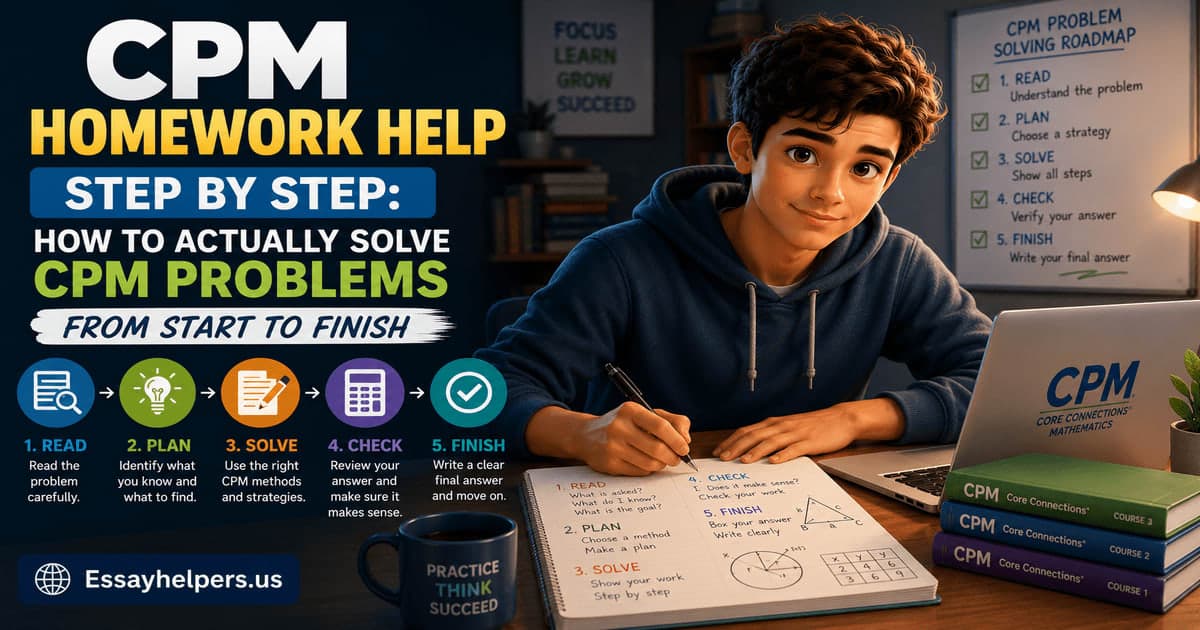
Step 1 — Read the full problem before writing anything
The first step in CPM homework help step by step is the one most students skip: reading the entire problem before picking up a pencil.
CPM problems frequently embed all the information you need across multiple sentences, a visual, and a follow-up question. Students who start calculating after the first sentence are almost always solving the wrong thing — because the actual question is in the third sentence, or the key constraint is in the diagram they scrolled past.
Read the full problem. Identify every piece of given information. Note what the problem is actually asking — including whether there is a calculation task and a justify-your-reasoning task. Both will need answers. Find both before you start either.
This step alone eliminates the most common CPM homework mistake: submitting a correct calculation for the wrong question, or submitting the right number without the written justification that earns the full marks.
Step 2 — Identify the topic and find the relevant CPM math notes
Once you've read the full problem, the second step in CPM homework help step by step is identifying which topic or concept the problem is testing.
CPM organises its homework by chapter, and each chapter covers specific mathematical concepts. If you're in a chapter on proportional relationships, a problem asking you to compare two quantities is almost certainly a proportional reasoning problem — even if it doesn't say so explicitly. Naming the topic before you start gives you the framework for the reasoning you'll need to write.
After identifying the topic, check the CPM math notes for that chapter section. Math notes are the reference boxes built into every CPM textbook. They condense the key method or concept into clear language — and they're CPM's version of the direct instruction that the curriculum delays until after discovery. If you're unsure which method CPM expects you to apply, the math note tells you before you invest time in the wrong approach.
This is where CPM problem-solving strategies start. Students who skip the math notes and try to work purely from memory hit walls that the math note would have resolved in thirty seconds.
Step 3 — Attempt the problem using CPM's reasoning structure
The third step in CPM homework help step by step is the attempt itself — and it has a specific structure that CPM expects students to follow.
CPM problems are not looking for the final answer alone. They're looking for the reasoning that leads to the final answer. That means your attempt should show the steps of your thinking, not just the calculation. Write down what you're doing as you do it. Don't wait until the end to add explanation.
For most CPM problem types, the reasoning structure looks like this: state what you know from the problem, identify the relationship or method you're applying and why, execute the calculation, and then explain what the result means in the context the problem set up. That last step — connecting the number back to the context — is the one most students skip, and the one that earns marks in CPM's justify-your-reasoning format.
Step-by-step CPM solutions that model this correctly show each of these stages in sequence. A solution that jumps from the problem statement to the final answer, with no visible reasoning in between, is not a CPM-format solution — it's a traditional math answer applied to a program that marks for process.
Enhance your Academic Performance And Reach Your Goals
See how quick and easy it is to get an exceptional essay with minimal effort on our platform
Step 4 — Write the justification as you go, not after
The justify-your-reasoning requirement is the most misunderstood part of CPM homework — and one of the most important parts of CPM homework help step by step.
Most students treat the justification as something you add after you've solved the problem. You calculate, get the answer, then go back and try to explain what you did. This approach fails consistently in CPM for one reason: students who can't reconstruct their reasoning after the fact demonstrate that the reasoning wasn't actually present during the calculation. CPM teachers can tell.
The correct approach is to write the justification as you work. At each step, write one sentence that explains what you're doing and why. "I set up a ratio because the problem describes a proportional relationship between..." or "I used the equation y = mx + b because the problem describes a linear relationship between..." These sentences don't have to be long. They have to be accurate, and they have to appear alongside the calculation — not only at the end.
This is the core of what CPM homework help step by step delivers when it's done correctly. The justification isn't a summary of the work. It's evidence that you understood the work as you did it.
Step 5 — Use checkpoints to verify you haven't missed a gap
After completing the main assignment problems, the fifth step in CPM homework help step by step is using CPM's Checkpoints to verify your understanding before moving to the review and preview section.
Checkpoints are cumulative practice problems placed at specific points in the CPM course. They test whether you've consolidated a concept before the spiral curriculum carries that concept into a more complex context. A Checkpoint problem that trips you up is diagnostic information — it tells you exactly which prior topic is still open, which gives you a specific target for the CPM problem-solving help you need.
Students who skip Checkpoints lose this diagnostic layer. They move into the review and preview section without knowing which earlier concept is fragile — and then can't identify why review and preview problems are harder than the main assignment.
Step 6 — Tackle the review and preview section with the same method
The review and preview section appears at the end of every CPM homework assignment and is the section most students handle worst — usually because they leave it for last, are tired, and rush through it.
The review and preview section is not an afterthought. It draws from any prior chapter in the CPM sequence — sometimes from a prior course — and carries real grade weight. Every problem in it deserves the same CPM homework help step by step approach as the main assignment problems: read fully, identify topic and check the math notes, attempt with written reasoning, write the justification alongside the calculation.
CPM homework help step by step that covers the review and preview section with the same depth as the main problems is the kind that actually closes the compounding gaps the spiral curriculum creates. Help that skips the review and preview section leaves the most consistent source of grade loss untouched. Every CPM homework help step by step session at Essay Helpers includes it as standard.
When the step-by-step method isn't enough
The CPM homework help step by step method above covers the process side of CPM problem-solving. But there's a second type of difficulty that process alone doesn't fix: genuine content gaps. If a review and preview problem is pulling from a CC1 concept you never fully understood, or if a CC3 problem requires CC2 algebra that wasn't consolidated, the step-by-step process will still stall — because the underlying concept isn't there.
This is when CPM homework help step by step from Essay Helpers makes the most difference. Rather than just showing you the steps, Essay Helpers provides step-by-step CPM solutions that include the written justification in CPM's format, connect the solution to the relevant math notes and checkpoint context, and cover the review and preview section as fully as the main problems.
Available 24/7, covering CC1, CC2, CC3, and every topic in the CPM sequence. If CPM homework help step by step is stalling on tonight's assignment, reach out before the deadline. CPM homework help step by step — with full written justifications, step-by-step CPM solutions, and review and preview coverage — is what closes the gap.
Want more topic updates?
Subscribe for new study resources, blog updates, and supporting cluster pages.
About the Author
Jonathan Avery
Ph.D. in Instructional Design, B.S. in Education