CVS Learnet pharmacy module: HIPAA, controlled substances & compliance
CVS Learnet pharmacy compliance modules test specific regulatory knowledge. Here's what HIPAA and prescription modules cover
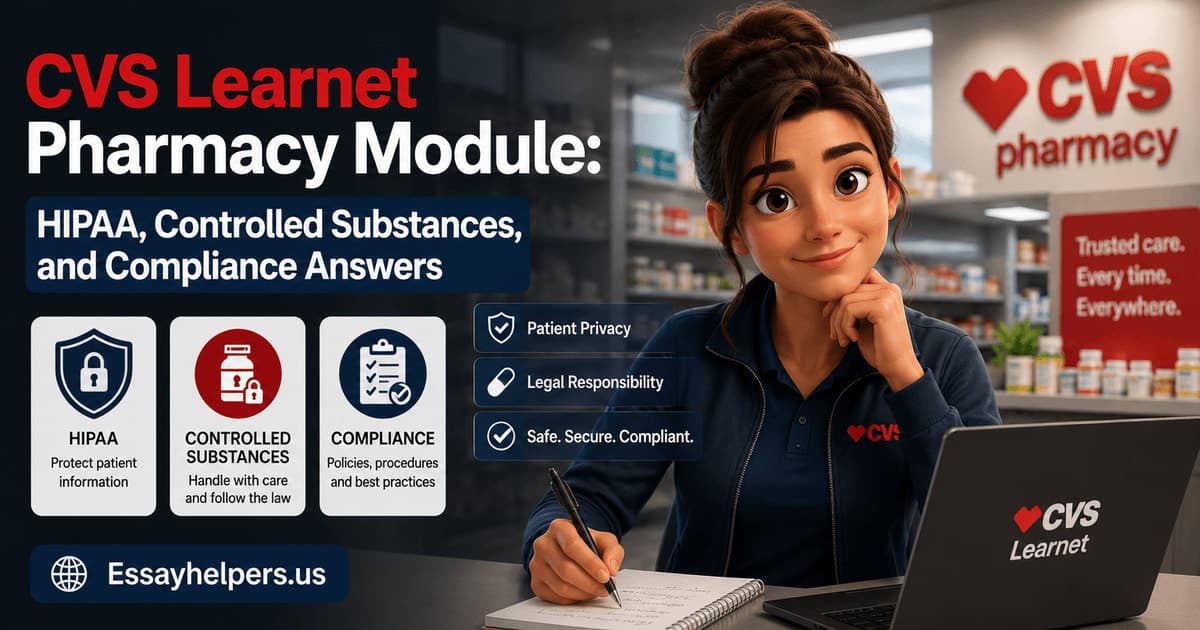
Pharmacy compliance modules on CVS Learnet are not the same as customer service training or store safety assessments — and the reason employees fail CVS Learnet HIPAA training answers comes down to treating regulatory modules like general knowledge tests. They test specific regulatory knowledge — the kind that changes when federal guidelines update, that varies by drug schedule, and that requires understanding not just what a rule says but why it exists and how it applies in a pharmacy setting.
CVS Learnet HIPAA training answers are not static facts you can memorise from a forum post — and neither are the controlled substance handling procedures and prescription verification requirements that appear in the same compliance category. They're regulatory frameworks that evolve with DEA scheduling updates, HHS guidance revisions, and state pharmacy board requirements. What a pharmacy employee needed to know about HIPAA patient privacy in 2023 is not identical to what CVS Learnet HIPAA training answers test in 2026.
This page explains what each major pharmacy compliance module on CVS Learnet actually tests — at the regulatory layer where CVS Learnet HIPAA training answers live, not just the surface summary level. If you're a pharmacy technician or pharmacist preparing for a compliance module with a tight deadline, understanding the regulatory structure behind CVS Learnet HIPAA training answers is what separates a confident correct answer from an educated guess.
What the CVS Learnet HIPAA module is actually testing — the regulatory layer explained
The CVS Learnet HIPAA training module does not test whether you know what HIPAA stands for. Every pharmacy employee knows the acronym. What CVS Learnet HIPAA training answers require is a working understanding of what the regulation actually mandates in a pharmacy context — and the distinctions within it that the assessment questions are written to surface.
HIPAA has two major rules that apply to pharmacy operations — and CVS Learnet HIPAA training answers draw from both. The Privacy Rule governs how protected health information (PHI) can be used, disclosed, and shared. The Security Rule governs how electronic PHI (ePHI) must be protected. CVS Learnet HIPAA training tests both — and the most commonly failed questions sit at the boundary between them, where employees assume the Privacy Rule covers something the Security Rule actually governs, or vice versa.
In a pharmacy setting, the Privacy Rule questions that appear most frequently when preparing CVS Learnet HIPAA training answers cover: what constitutes a permitted disclosure of PHI (treatment, payment, healthcare operations vs everything else); what the minimum necessary standard requires when sharing patient information internally; and what a patient's right of access means in practice at a pharmacy counter. These are operational questions dressed in regulatory language — they test whether you know the difference between a permitted disclosure for treatment purposes and one that requires a signed authorization form.
The Security Rule questions focus on ePHI — prescription records in the pharmacy management system, patient profiles, refill history. CVS Learnet assessment questions in this area test whether employees understand the administrative, physical, and technical safeguards the Security Rule requires: who can access patient records, what constitutes an unauthorized access event, and what must be reported under the Breach Notification Rule.
CVS Learnet HIPAA training answers that consistently earn full marks come from employees who understand the regulatory intent behind each rule — intent that the module teaches but that generic study guides rarely explain, not just the rule itself. An employee who knows that the minimum necessary standard exists because HIPAA was designed to limit PHI exposure to what's required for the specific purpose at hand will navigate a nuanced assessment question correctly — even one phrased in a scenario format they haven't seen before.
Enhance your Academic Performance And Reach Your Goals
See how quick and easy it is to get an exceptional essay with minimal effort on our platform
HIPAA Privacy Rule vs Security Rule — what pharmacy employees need to know
The distinction between the Privacy Rule and the Security Rule is where most pharmacy employees lose marks on CVS Learnet HIPAA training, and it's worth addressing directly.
The Privacy Rule applies to all forms of PHI — spoken, written, and electronic. It governs what information can be shared, with whom, and under what circumstances. In a pharmacy context, this means the rule covers: what you can tell a patient's family member about their prescription without authorization, what you can say at the pharmacy counter about a patient's medication when other customers are nearby, and what you can share with a physician's office for treatment coordination.
The Security Rule applies only to electronic PHI. It governs how that information is stored, accessed, transmitted, and protected. In a pharmacy context, this means the rule covers: password requirements for the pharmacy management system, encryption standards for any ePHI transmitted outside the pharmacy network, and the physical security controls that prevent unauthorized access to workstations displaying patient records.
CVS Learnet HIPAA training answers for scenario-based questions require you to identify which rule applies before applying the correct response — CVS Learnet assessment questions in the HIPAA module frequently present a scenario — a pharmacist overheard by another customer, a technician accessing a patient record outside their current workflow, a prescription printed and left visible at the counter — and ask which rule applies and what the correct response is. Employees who have memorised definitions without understanding which rule governs which context will select the wrong regulation for the scenario even when they know what both rules say.
For CVS pharmacy Learnet answers to HIPAA scenarios — and for CVS Learnet HIPAA training answers more broadly — the working principle is: if the question involves sharing, disclosing, or discussing PHI in any form, it's a Privacy Rule question. If it involves electronic storage, access controls, or data transmission, it's a Security Rule question. Any scenario that involves both — an ePHI record being shared externally without authorization — touches both rules and will be assessed accordingly.
DEA Schedule II–V controlled substances — how CVS Learnet tests handling procedures
CVS Learnet controlled substance training sits within the same compliance category as CVS Learnet HIPAA training answers — and like HIPAA, it tests regulatory knowledge that is both technically specific and operationally consequential. A pharmacy technician who handles Schedule II medications incorrectly creates a DEA compliance gap — not just a training record issue.
The DEA scheduling framework organises controlled substances into five schedules based on accepted medical use and potential for abuse and dependence. CVS Learnet controlled substance training assessment questions are written around the practical implications of each schedule for pharmacy operations — not around the academic definitions the DEA publishes.
Schedule II substances — which include opioids like oxycodone and hydrocodone, stimulants like amphetamine, and certain depressants — require the strictest handling procedures. CVS Learnet controlled substance training covers what a Schedule II prescription requires that a Schedule III or IV prescription does not: no refills, no verbal orders from prescribers except in specific emergency circumstances, mandatory DEA Form 222 for ordering, and specific count requirements for inventory reconciliation.
The CVS Learnet training modules answers — and the CVS Learnet HIPAA training answers that mirror them in structure — that fail most often in the controlled substance section are those where employees conflate the requirements for different schedule levels. A Schedule II opioid prescription cannot be refilled — ever, for any reason, regardless of the prescriber's wishes. A Schedule III or IV prescription can be refilled up to five times within six months of the original issue date. CVS Learnet controlled substance training tests this distinction repeatedly because it is the one that generates the most real-world pharmacy compliance errors.
Learnet answers for healthcare modules covering controlled substances also address the documentation requirements for dispensing discrepancies. If a controlled substance count in the pharmacy doesn't reconcile — if the inventory shows more or fewer units than dispensing records account for — there is a mandatory reporting and investigation process. CVS Learnet tests whether employees know what triggers that process, who initiates it, and what the timeline requirements are.
Prescription verification requirements — what the pharmacy compliance module covers
Prescription verification is the third major category alongside CVS Learnet HIPAA training answers in CVS Learnet pharmacy compliance training, and it sits at the intersection of state pharmacy board requirements and federal DEA regulations.
A valid prescription requires specific elements — prescriber information, patient information, drug name, strength, quantity, directions for use, and the prescriber's DEA registration number for controlled substances. CVS Learnet pharmacy compliance training tests whether employees can identify a valid prescription, recognise the elements that would make a prescription invalid or suspicious, and know what the correct response is in each case.
The questions that appear most frequently in CVS pharmacy Learnet answers on this topic are scenario-based: a prescription presented with an unusual quantity, a prescriber DEA number that doesn't match the prescriber's state, a patient requesting an early refill on a Schedule III medication, a prescription that appears to have been altered. For each scenario, the assessment tests what the correct pharmacy response is — what verification steps are required, what can be dispensed, what must be refused, and what must be reported.
CVS Learnet assessment questions in this category also cover the pharmacist's corresponding responsibility doctrine — the legal principle that a pharmacist has independent professional and legal responsibility for every prescription they fill, regardless of what the prescriber wrote. This principle is the regulatory basis for why a pharmacist can and must refuse to fill a suspicious prescription even when the prescriber insists it is legitimate. CVS Learnet pharmacy compliance training — in the same way that CVS Learnet HIPAA training answers test the limits of disclosure authority — tests whether employees understand that the pharmacist's responsibility is not subordinate to the prescriber's authority in situations where the prescription's validity is in question.
Enhance your Academic Performance And Reach Your Goals
See how quick and easy it is to get an exceptional essay with minimal effort on our platform
How CVS Learnet pharmacy compliance training updates with regulatory changes
This is the feature of pharmacy compliance modules that makes static answer files and outdated study guides particularly unreliable — and the reason CVS Learnet HIPAA training answers must be sourced from current regulatory knowledge, not archived materials.
DEA scheduling decisions change. Drugs move between schedules when the abuse potential assessment changes — a medication that was Schedule IV can become Schedule III or Schedule II when new data on dependence or diversion emerges. When that happens, the handling requirements change immediately for every pharmacy in the country. CVS Learnet pharmacy compliance training updates its module content to reflect these changes, which means CVS Learnet HIPAA training answers and controlled substance module content from twelve months ago may no longer reflect current regulatory requirements.
HHS guidance on HIPAA enforcement priorities also evolves — and this is exactly why CVS Learnet HIPAA training answers from twelve months ago may already be missing regulatory context the current module tests. In recent years, HHS OCR has issued guidance on telehealth PHI, reproductive health information privacy, and cybersecurity incident response that affects what a pharmacist or technician needs to know about their obligations. CVS Learnet incorporates this updated guidance into its HIPAA training module content — which means Learnet pharmacy answers sourced from pre-guidance materials will be missing the regulatory context the current assessment tests.
State pharmacy board requirements add a third layer of variation. CVS operates pharmacies in states with different controlled substance requirements — some states have stricter Schedule II dispensing rules than federal law requires, some have specific partial dispensing regulations that differ from federal defaults. CVS Learnet training modules answers for controlled substance assessments may reflect state-specific requirements for the employee's location, which means a generic national study guide will not cover everything the assessment tests.
This regulatory currency problem is the core reason why CVS Learnet HIPAA training answers cannot come from cached documents — they need to come from a source with current subject knowledge — not from a cached document that reflected the regulatory environment when it was written.
If you're working through other CVS Learnet compliance modules alongside pharmacy training — particularly customer service and loss prevention assessments, which have their own regulatory layer around transaction monitoring and employee conduct — the section on those modules covers the non-pharmacy compliance content in detail.
Why a healthcare background helps — and what employees without one need instead
Pharmacy technicians with prior healthcare training have a structural advantage in CVS Learnet pharmacy compliance modules — not because they've studied HIPAA more, but because regulatory frameworks make intuitive sense when you've already operated inside one.
An employee who has worked in any healthcare setting before joining CVS pharmacy already understands that patient information is sensitive, that medication handling has documented procedures, and that compliance failures have professional consequences. That contextual understanding means regulatory language lands differently — the rules make sense because the underlying concern is already familiar.
For pharmacy technicians new to healthcare, the regulatory layer can feel abstract in a way that affects assessment performance. A question about minimum necessary disclosure is harder to answer correctly when you've never had to navigate the decision in practice — when the rule feels like a legal technicality rather than a functional guide to a real situation. This is the gap that subject-specialist support fills for new healthcare employees facing CVS Learnet controlled substance training or HIPAA compliance modules.
A healthcare compliance specialist who understands the current state of CVS Learnet HIPAA training answers — why the minimum necessary standard exists — because HIPAA was designed to limit PHI exposure to what's operationally required, not to what's convenient — gives a new pharmacy technician the interpretive framework that makes the assessment questions navigable. Not just the correct answer to the specific question, but the reasoning that produces the correct answer to any question on the same topic.
The broader breakdown of CVS Learnet modules by subject — including which other compliance categories appear in assessments and which ones update most frequently — is covered in the complete CVS Learnet answers guide.
Getting CVS Learnet HIPAA training answers matched to the current module version
The practical challenge most employees face when looking for CVS Learnet HIPAA training answers is not finding information about HIPAA — it's finding information that reflects the current version of CVS Learnet's compliance module specifically.
HIPAA information is widely available. What isn't widely available is an accurate account of which HIPAA concepts CVS Learnet's current pharmacy compliance training module tests, in what format, at what level of regulatory specificity, and with what scenario structure. Generic HIPAA study guides and forum answer posts don't provide this — they provide general regulatory information that may or may not align with what the current module version assesses.
Getting CVS Learnet HIPAA training answers that hold up under assessment conditions requires subject knowledge matched to the current module version — regulatory currency plus familiarity with how CVS Learnet HIPAA training answers are structured at the assessment level — regulatory currency plus familiarity with how CVS structures its compliance assessment questions. Essay Helpers provides CVS Learnet HIPAA training answers and broader pharmacy compliance training support through healthcare compliance specialists who understand the current regulatory environment and the CVS Learnet assessment format.
Whether you're facing a same-day deadline on a HIPAA module, working through controlled substance training for the first time without a healthcare background, or preparing for prescription verification assessments as part of a new role, reach out with your module details and deadline. We'll confirm specialist matching and turnaround before you commit — 24/7, for CVS Learnet HIPAA training answers and every other pharmacy compliance module in the catalog.
Want more topic updates?
Subscribe for new study resources, blog updates, and supporting cluster pages.
About the Author
Jonathan Avery
Ph.D. in Instructional Design, B.S. in Education