

How to write an enduring issues essay in 2026 (step-by-step guide)
Not sure how to write an enduring issues essay? This step-by-step guide covers format, thesis, outline, rubric, and when to get expert essay help
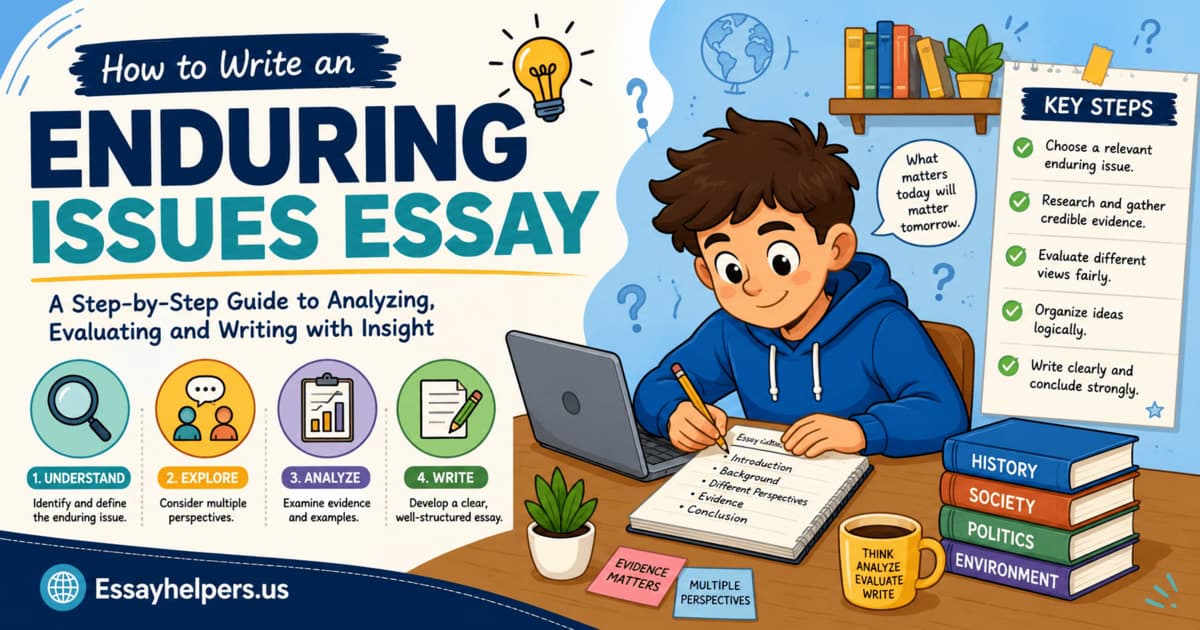
Your teacher hands back an assignment sheet. You read the task: write an enduring issues essay. You stare at it for thirty seconds wondering what that means — and whether you're already behind.
You're not alone. The enduring issues essay is one of the most misunderstood writing assignments in the Global History and Geography course, especially for students preparing for the NYS Regent Exam. Most students freeze not because they lack ideas, but because no one has explained what the task actually requires. This guide changes that.
Learning how to write an enduring issues essay is something every Global History student needs to do at some point — and when you understand the process step by step, it becomes far less intimidating. Here's what you'll walk away with: a clear picture of what an enduring issues essay is, a practical method for writing one from scratch, the exact enduring issues essay format your teacher is looking for, and honest advice on how to get enduring issues essay help if you're still stuck after reading every word of this enduring issues essay guide.
What is an enduring issues essay and why does it matter?
Before you figure out how to write an enduring issues essay, you need to understand what the assignment is actually asking.
An enduring issue is a historically significant challenge — a problem that has appeared repeatedly across different time periods, different societies, and different generations. It doesn't get fully solved. It shifts shape. It comes back. Inequality is an enduring issue. So is the tension between individual rights and state power. So is the scarcity of resources that drives conflict between nations.
What is an enduring issues essay, then? It is a written task where you identify one of these long-running challenges, prove it has affected multiple groups across history, and argue why it matters — all using historical evidence as your support.
What is an enduring issue in exam terms? The NYS Regent Exam definition is specific: it must be a challenge that has been significant across time and place, addressed by different groups with varying degrees of success, and still relevant in some form today. A one-time disaster doesn't qualify. A recurring pattern of human conflict, suppression, or resource competition does.
This essay type is a core part of the Global History and Geography NYS Regent Exam. It tests whether you can think historically, build an argument, and support it with documents. It is not just a summary of events. It is an analytical piece that connects the past to the present.
Students who score poorly on this task almost always make the same error: they describe events without making an argument. Students who score 5 on the enduring issues essay scoring scale understand that every paragraph must serve their central claim — that this issue has persisted, that it has impacted people significantly, and that historical evidence proves both points.
That distinction matters before you write a single sentence.
Understanding the enduring issues essay format before you write
Structure is everything in this essay. Before you start drafting, you need to know exactly what the enduring issues essay format looks like — because writing without a clear structure is one of the fastest ways to lose marks.
The standard enduring issues essay format has four core components.
The introduction is where you identify the enduring issue, define it, and present a clear thesis statement that makes an argument about how and why this issue has persisted across history.
The body section is where you develop your argument across multiple enduring issues essay body paragraphs. Each paragraph introduces evidence from a historical document or source, explains it, and connects it back to your thesis. Most teachers expect you to reference at least three separate documents.
The analysis layer runs through every body paragraph. Within each one, you show how the issue evolved across different time periods and societies. You are not listing events — you are showing continuity and change over time.
The conclusion closes the essay. You restate your argument in fresh language, summarise the key evidence briefly, and explain the broader significance of the issue.
This enduring issues essay structure is consistent across the NYS Regent Exam enduring issues essay and most Global History classroom assignments. If your teacher has given you a slightly different format requirement, follow that — but these four components will almost always appear in some form. Understanding the enduring issues essay format before you begin is the single most effective preparation step you can take.
Enhance your Academic Performance And Reach Your Goals
See how quick and easy it is to get an exceptional essay with minimal effort on our platform
How to build your enduring issues list and pick the right topic
Choosing the right topic is one of the most important decisions you will make — and students often rush it.
If your assignment provides documents to work from, your job is to identify which enduring issue is best supported by those documents. Read them first. Look for patterns. What problem keeps appearing across different sources? That is your issue.
If you are choosing freely, here is a reliable enduring issues list to work from:
Conflict — wars, civil disputes, and the failure of diplomacy across history. Inequality — in wealth, rights, race, gender, and political power. Power — who holds it, how they use it, and what happens when it is abused. Scarcity — the competition over land, food, water, and natural resources. Environmental impact — how human activity has degraded or transformed the natural world. Cooperation — the struggle of nations or groups to work together toward shared goals. Human rights violations — the recurring suppression of freedom and dignity. Innovation — the uneven distribution of technological change across societies. Interconnectedness — how global trade, migration, and communication link societies together.
Once you have picked a topic from the enduring issues list, ask: can I find at least three pieces of historical evidence that support this? If yes, you have a workable topic.
Your choice of enduring issues essay topics matters more than most students realise. Pick something you find interesting. Writing about an issue you care about even slightly makes the whole enduring issues essay stronger — your argument will feel more genuine, and that comes through on the page. If you are unsure which of the available enduring issues essay topics suits your evidence best, choose the one where you can clearly name at least three historical moments that prove the issue persisted.
How to write an enduring issues essay introduction that hooks your reader
The introduction is where most students lose the reader — and lose marks.
A strong enduring issues essay introduction does three things: it names the issue, it argues something about it, and it tells the reader what to expect. Knowing how to write an enduring issues essay introduction well is a skill that takes practice, but the formula is straightforward once you see it.
It does not start with a dictionary definition, a vague historical observation, or a sentence that could belong to any essay ever written.
Here is a weak opening: "Throughout history, many civilisations have faced many challenges." That sentence tells the reader nothing. Restart
A stronger enduring issues essay introduction opens with the issue itself and makes a claim immediately. Here is an example: "Inequality in power and rights has driven some of the most significant upheavals in human history — from slave revolts in ancient Rome to the civil rights movement in 20th-century America — and it remains unresolved today." That opening does the work. It names the issue, gestures at historical breadth, and implies an argument.
Your introduction should be around 100 to 150 words. It must contain your thesis statement, and it must establish the enduring issue you are arguing about. Do not bury your argument in the third paragraph. Put it at the end of the introduction, where the reader expects to find it.
One more thing: avoid starting with a question. It can work occasionally, but teachers have read thousands of enduring issues essay introductions that open with "Have you ever wondered why inequality exists?" Start with a statement you can defend.
Writing a strong enduring issues essay thesis statement
Your enduring issues essay thesis statement is the most important sentence in the whole paper. Get it wrong, and the rest of the essay struggles to hold together. Get it right, and every paragraph writes itself more easily.
A good enduring issues essay thesis statement must do three things. First, name the issue clearly — not vaguely. "Inequality" is specific. "Various problems in history" is not. Second, make a claim about it — explain what you are arguing: that this issue has persisted across time, affected multiple groups, and been addressed without ever being fully resolved. Third, signal the historical scope — give the reader a sense of the time periods or societies you will be covering.
Here is a weak thesis: "Inequality is an enduring issue that has affected people." It names the issue but makes no real claim and gives no historical scope.
Compare it to this: "Inequality in political power has repeatedly driven social unrest across history, from the peasant revolts of medieval Europe to the independence movements of the 20th century, demonstrating that unchecked power imbalance consistently produces resistance."
That enduring issues essay thesis statement names the issue, makes a specific argument, and signals the historical scope. It is debatable — which is exactly what a thesis should be.
Write your thesis before you draft anything else. It should guide every body paragraph you write. If a paragraph does not serve the thesis, cut it or revise it until it does.
How to structure your enduring issues essay body paragraphs
The body of your essay is where your argument lives. Strong enduring issues essay body paragraphs follow a consistent pattern that keeps your argument clear and your evidence connected.
Each body paragraph should contain four parts.
A topic sentence tells the reader what this paragraph is about and how it connects to your thesis. Lead with the point — do not bury it.
Historical evidence supports the topic sentence. Reference a specific document, event, or source. Name it explicitly. "According to Document 3, the peasant revolts of 1381 were driven by..." is far stronger than "In the document, it says..."
Analysis explains what the evidence shows. Do not assume the reader will connect evidence to argument automatically. Your job is to make that link explicit in writing.
A closing sentence ties the evidence back to the enduring issue. Show how this example proves the issue persisted, mattered, or was addressed without being resolved.
Most NYS Regent Exam enduring issues essay rubrics expect at least three enduring issues essay body paragraphs, each drawing on a different document or source. Spreading your evidence across different time periods strengthens your argument — it shows that the issue truly endured across history, not just that it appeared once.
Good use of enduring issues essay transition words between paragraphs matters too. Phrases like "Similarly, across a different era..." or "While this document shows one dimension of the issue, the next reveals another..." keep the argument flowing without jarring jumps between ideas. Transitions are not just stylistic — they show the marker that your argument is structured and intentional, not accidental. Strong enduring issues essay transition words signal that you understand how to connect historical evidence into a coherent claim rather than listing isolated facts.
Enduring issues essay outline: the exact structure to follow
Before you write, build a plan. An enduring issues essay outline saves time and keeps your argument on track.
Here is the exact structure to follow.
Introduction covers 100 to 150 words. Include a hook that names the issue and its significance, a brief historical frame, and your thesis — the central argument.
Body Paragraph 1 covers 150 to 200 words. It opens with a topic sentence linking to the thesis, presents evidence from your first document or source, provides analysis connecting that evidence to the enduring issue, and closes with a sentence tying back to the thesis.
Body Paragraph 2 covers 150 to 200 words in the same structure, drawing on a different time period or society.
Body Paragraph 3 follows the same pattern for a third time period or perspective.
The conclusion covers 100 to 150 words. Restate the thesis in different words, summarise the key evidence briefly, and close with a statement about the broader significance of the issue.
This enduring issues essay outline meets the standard rubric requirements across most Global History assignments and the NYS Regent Exam enduring issues essay. Adjust the number of body paragraphs to match your teacher's instructions — some ask for four or five.
Spend five minutes building this outline before you write. Students who skip this step produce essays that wander. The outline is the architecture — everything else is filling the rooms. This is the single most practical piece of advice in this entire enduring issues essay guide.
Enhance your Academic Performance And Reach Your Goals
See how quick and easy it is to get an exceptional essay with minimal effort on our platform
Writing your enduring issues essay conclusion the right way
The enduring issues essay conclusion is where students either seal their argument or unravel it. Most teachers read the conclusion carefully because it shows whether you understood what the task was actually asking.
A strong conclusion restates your thesis in different words — not the same sentence copied and pasted from the introduction. Then it briefly summarises the evidence used across the body paragraphs. One or two sentences per piece of evidence is enough. You are not re-explaining everything — you are reminding the reader of the shape of your argument.
End with a statement about the broader significance of the issue. Why does this matter beyond the essay itself? How does the enduring issue connect to the world today? That final observation is what separates a solid enduring issues essay conclusion from a memorable one.
Here is what not to do. Do not start with "In conclusion." It adds nothing. Do not introduce new evidence — everything new belongs in the body. Do not write a vague final line like "This issue is still important today." Say why it is still important. Name a specific modern parallel if you can.
A well-written enduring issues essay conclusion takes about ten minutes to draft once the rest of the essay is done. Do not rush it. It is the last thing your teacher reads before assigning a score.
The enduring issues essay rubric — what markers actually look for
Understanding the enduring issues essay rubric is one of the smartest things you can do before you begin writing.
Most rubrics — including the NYS Regent Exam enduring issues essay rubric — assess five core areas.
First, you must identify the issue correctly. You must name a genuine enduring issue, not a one-time event. The Black Death is not an enduring issue. The spread of disease and its effects on political power is.
Second, you must prove the issue has affected multiple groups. Your evidence must span different time periods, societies, or communities. One example is not enough to demonstrate that something has truly endured.
Third, you must build a clear argument. A strong enduring issues essay thesis statement that runs through every paragraph is not optional — it is the difference between a 3 and a 5 on the enduring issues essay scoring scale.
Fourth, you must use historical evidence correctly. Document references must be accurate. Analysis must be specific. Vague generalisations lose marks.
Fifth, you must write clearly. Grammar, structure, and readability all count. An essay that makes a strong argument but is difficult to follow will not reach the top of the scoring range.
When you understand the enduring issues essay rubric before you write, you stop writing for yourself and start writing for the marker. That shift makes a real difference to your final grade.
NYS Regent Exam enduring issues essay: key scoring rules to know
If you are preparing for the NYS Regent Exam, the Global History and Geography enduring issues essay is worth understanding in specific detail — not just as a writing task, but as a scored performance.
The NYS Regent Exam enduring issues essay scoring uses a scale of 0 to 5. Here is what each level generally reflects.
Score 5 means a fully developed argument. The thesis is clearly stated and supported. Three or more documents are used accurately with strong analysis. The historically significant challenge is correctly identified, and its persistence across time and society is clearly demonstrated throughout. This is what learning how to write an enduring issues essay at the highest level looks like in practice.
Score 4 means a developed argument with a clear thesis. At least two documents are used with adequate analysis. Minor gaps exist in historical accuracy or argument development.
Score 3 means a partial argument. The thesis is present but underdeveloped. Documents are referenced but analysis is surface-level or inconsistent.
Score 2 means a limited argument. The thesis is weak or missing. Document usage is minimal or inaccurate.
Score 1 or 0 means little to no relevant argument. Documents are misused or absent.
Most students sit between a 3 and a 4. Moving from a 3 to a 5 is almost always about the depth of analysis — not the number of facts listed. Write less description. Write more argument. That is the core lesson in this enduring issues essay guide.
One variation worth knowing is the enduring issues essay DBQ format — document-based question. In a DBQ, all your evidence comes from the documents provided in the exam packet. The enduring issues essay DBQ asks you to read each document carefully, identify the issue they collectively point to, and build your argument using only what is in front of you. The structure and enduring issues essay outline remain the same — introduction, body paragraphs, conclusion — but your evidence sourcing is constrained to the packet. Students who understand the enduring issues essay DBQ format before exam day have a significant advantage over those who see it for the first time under timed conditions.
When to get enduring issues essay help (and what that looks like)
Not every student gets stuck because they are not trying. Sometimes the assignment is not clicking, the deadline is close, and you need support that actually moves things forward. That is not failure — it is knowing when to ask.
There are a few situations where getting professional enduring issues essay help makes real sense.
You have read the prompt three times and still do not know where to start. That is a clear signal that you need someone to walk you through the task — not hand you a generic enduring issues essay examples document, but explain the logic behind the structure and help you apply it to your specific topic and documents.
You have a draft but no idea whether it is strong enough. Feedback from someone who understands the enduring issues essay rubric is far more useful than rereading your own work. A second pair of eyes catches argument gaps, weak analysis, and structural problems that are hard to see when you are too close to the writing.
You genuinely do not have enough time. Assignments stack up, deadlines collide, and some weeks just do not go the way you planned. If you are in that position and need someone to write my enduring issues essay or want to explore enduring issues essay assignment help options, the Essay Helpers team is available 24/7.
An enduring issues essay writing service that genuinely understands this assignment type is worth distinguishing from generic essay mills. You want a service where the enduring issues essay writer assigned to your task knows the difference between the enduring issues essay and a standard history essay — and knows what the NYS Regent Exam enduring issues essay scoring rubric is actually looking for. Those are not the same thing as general academic writing experience.
Looking at strong enduring issues essay examples is also useful before you write — not to copy, but to see what a well-constructed argument looks like in practice. If you cannot find good examples, ask your teacher, check your school's past papers, or reach out to a professional service that can show you what top-scoring responses look like.
Professional enduring issues essay writing means working with subject specialists who understand the Global History and Geography enduring issues essay rubric, know what a strong enduring issues essay thesis statement looks like in context, and can produce a complete, original essay that meets your assignment requirements. The enduring issues essay writer on your task should be someone who treats this as a distinct genre of academic writing — because it is.
If you want to pay someone to write enduring issues essay content that genuinely reflects the task, choose a service that has handled this specific assignment type before. Ask if they have written Global History essays before. Ask if they are familiar with the enduring issues essay format, the enduring issues essay outline structure, and the rubric's requirements.
Reach out to the Essay Helpers team today. Whether you need a full enduring issues essay, a detailed enduring issues essay outline, targeted enduring issues essay help on your thesis, or a full enduring issues essay assignment help package that covers everything from topic selection to a polished final draft — professional academic support is one message away.
Enjoyed this article?
Subscribe to our newsletter for more insightful content, academic tips, and exclusive updates.
About the Author
Daniel R. Fitzgerald
Ph.D. in Curriculum & Instruction, M.A. in Secondary Education

How to use AI in the classroom: 10 practical ways teachers exploit
AI in the classroom isn't just hype. These 10 use cases show how teachers are saving time and making their lessons better

How to Write a Perfect Essay: A Comprehensive Guide
Learn the essential steps to write outstanding essays with our comprehensive guide. From structure to research tips, master academic writing today.