

How to use AI in the classroom: 10 practical ways teachers exploit
AI in the classroom isn't just hype. These 10 use cases show how teachers are saving time and making their lessons better
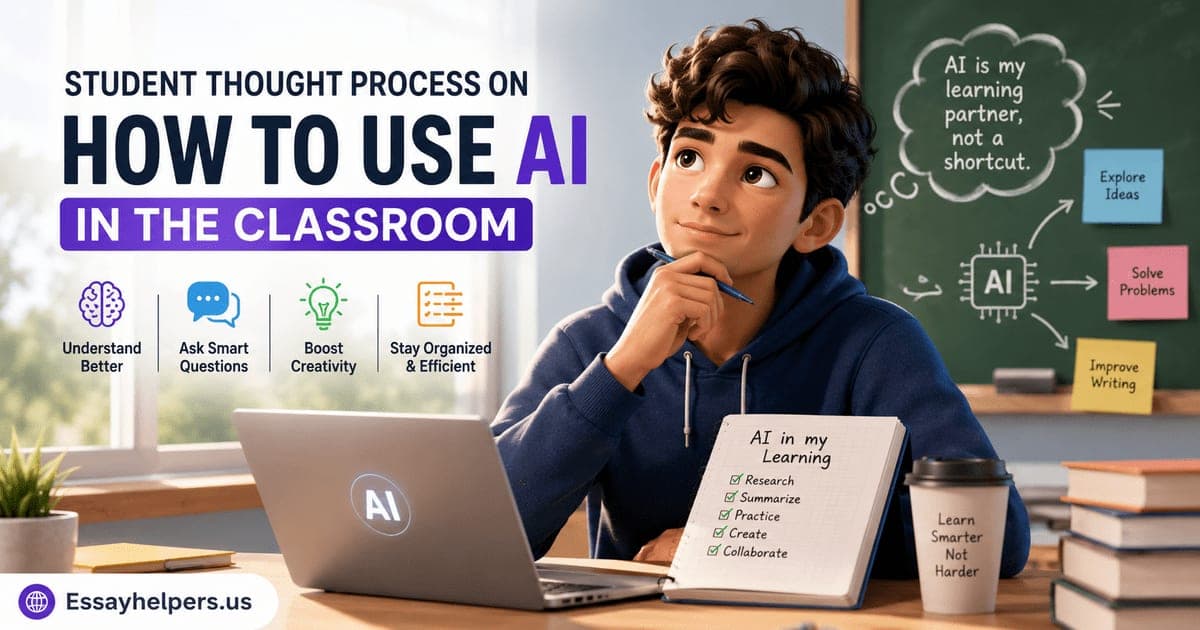
You've seen the headlines. You've heard colleagues talk about it in the staffroom. Maybe a student has already handed in work that made you wonder. AI in the classroom is no longer a future conversation — it's happening right now, in schools across the country, and teachers who figure out how to use AI in the classroom well are getting ahead. The good news: how to use AI in the classroom is a genuinely learnable skill, and this guide covers exactly that.
This guide covers 10 specific, practical ways to use AI in the classroom. Not theory. Not speculation. Real use cases, with real tools, that teachers are already applying. Each one is a concrete answer to the question of how to use AI in the classroom that you can test this week, not next semester. If you want to know how to integrate AI in the classroom without feeling overwhelmed, this is where to start. And if you need academic support for students who are still catching up while you navigate all of this, the Essay Helpers team is available 24/7.
Their experts are also fluent in dealing with Odsseyware Answers and Apex Answers
What using AI in the classroom actually looks like in 2026
Before the use cases, a quick reset on what AI in the classroom actually means for most teachers.
It doesn't mean handing your lessons over to a machine. It doesn't mean students staring at chatbots instead of thinking. And it definitely doesn't mean you need to become a technology expert to keep up. Knowing how to use AI in the classroom well is a skill — and like every teaching skill, you build it by doing it, not by waiting until you feel ready. The teachers asking how to use AI in the classroom in 2026 are the same teachers who asked how to use interactive whiteboards in 2010 — the question is the same, and so is the answer: you learn by trying.
What it does mean is this: there are classroom AI tools available right now that can handle the most time-consuming parts of your job — the prep, the repetitive feedback, the administrative load — so you can spend more of your time doing what only a human teacher can do. Building relationships. Asking the questions that push students to think harder. Noticing the student who's struggling before they fall behind.
AI tools for teachers are not replacements. They're the most capable teaching assistants most educators have ever had access to. The teachers using them well are not working less — they're working smarter, reaching more students, and producing better outcomes with the same hours. That's what it means to know how to use AI in the classroom. Here's what that looks like in practice.
1. AI for lesson planning — cut prep time in half
Ask any teacher what takes the most time outside the classroom, and lesson planning comes up first. Building differentiated materials, sourcing resources, writing objectives that align with standards — it adds up to hours every week.
This is where AI tools for teachers deliver the clearest return. Tools like MagicSchool AI and Brisk Teaching can generate a full lesson plan in under two minutes. You give it the subject, the grade level, the learning objective, and any context you need — students who need scaffolding, an upcoming assessment, a standard you're targeting — and it drafts a complete plan with activities, discussion questions, and extension tasks.
The plan won't be perfect straight out of the tool. You'll edit it. You'll add your own examples, cut what doesn't fit your class, and adjust the timing. But you're editing a draft, not building from a blank page. For most teachers, that shift alone recovers between 30 minutes and two hours per week.
ChatGPT for teachers works well for lesson planning too, particularly for generating differentiated versions of the same lesson — one for grade-level students, one with scaffolding, one with extension activities — all from a single prompt. The key is learning how to prompt it well, which takes about a week of practice before it becomes second nature.
One practical tip: save your best prompts. Once you find a prompt that generates the kind of lesson structure you actually use, keep it. Adapt it for each new unit rather than starting over each time. Teachers who understand how to use AI in the classroom for lesson planning report this becomes the first place the time savings really stack up. And once you know how to use AI in the classroom for one subject, replicating the workflow across others takes a fraction of the original time.
Enhance your Academic Performance And Reach Your Goals
See how quick and easy it is to get an exceptional essay with minimal effort on our platform
2. AI for differentiated instruction — personalise without extra work
Differentiated instruction is one of the most demanding expectations placed on classroom teachers. You're supposed to meet students where they are — different reading levels, different background knowledge, different learning needs — while teaching 25 or 30 students at once with the same amount of time.
AI differentiated instruction tools change that equation. Platforms like Diffit take a text, article, or topic and generate versions at multiple reading levels automatically. You can give a struggling reader a version of the same content as an advanced reader, adapted to their level, without writing two separate materials from scratch.
This isn't just convenience. Students who consistently receive materials pitched above their level disengage. Students who receive materials pitched at their level stay in the lesson. Research from the National Center for Education Statistics is clear on this: when students can access content at an appropriate level, comprehension and retention both improve significantly. Knowing how to use AI in the classroom for differentiation is, for many teachers, the use case that finally makes this standard achievable.
Using AI in the classroom for AI differentiated instruction also means you can personalise the questions you ask. Generative AI in education tools can generate discussion questions, exit tickets, and homework tasks calibrated to the level of individual students. You set the parameters; the tool does the scaling.
For teachers who serve students with IEPs or 504 plans, this is particularly valuable. Generating accommodation-adjusted materials used to take significant extra time. With the right classroom AI tools, it becomes a matter of adding a line to your prompt. Teachers who know how to use AI in the classroom for differentiation describe it as the use case that finally makes inclusion manageable rather than just mandated — and that's a significant shift in how to use AI in the classroom in a way that actually changes outcomes.
3. AI as a teaching assistant — automate the repetitive stuff
Every teacher knows the tasks that eat time without requiring their actual expertise. Formatting materials. Writing rubric descriptors. Generating quiz questions on content already covered. Sending progress updates. These tasks need to be done — but they don't need a trained educator to do them.
An AI teaching assistant handles exactly this category of work. Tools like Brisk Teaching integrate directly into Google Docs and Slides. You can highlight a passage and ask it to generate comprehension questions, create a rubric from your assignment description, or write a simplified version of a complex text — all without leaving the document you're already in.
MagicSchool AI has a broader toolkit — over 60 tools covering everything from generating parent communication emails to writing student report comments based on assessment data you provide. Teachers using it report saving between three and five hours per week on administrative tasks alone.
The shift this creates matters beyond just time. When you're not spending your planning period on tasks that don't require you, you spend it on the things that do — reviewing student work, identifying patterns in assessment data, preparing for the student who needs a different approach tomorrow.
Think of it this way: you're the teacher. The AI is the assistant who never complains about doing the paperwork. That's a significant part of how to use AI in the classroom in a way that genuinely improves your working week rather than just adding another tool to manage. And once the admin tasks are handled, you get to teach.
4. AI for formative assessment — real-time insight on student understanding
Formative assessment is the backbone of good teaching. It tells you where students are before the high-stakes test, when there's still time to adjust. But traditional formative assessment — exit tickets, quick writes, mini-quizzes — takes time to collect, time to read, and time to interpret. By the time you know where the class is, the lesson has already moved on.
Using AI in the classroom changes the speed of that feedback loop — and knowing how to use AI in the classroom for formative assessment is one of the highest-leverage skills a teacher can develop. Tools like Kahoot AI, Quizbot, and SchoolAI can generate formative assessment questions on any topic in seconds. Some platforms — like Khan Academy's Khanmigo — can identify which students are struggling with specific concepts in real time and flag them for teacher follow-up.
What this means practically: you can run a five-question exit ticket at the end of a lesson, get a class-level summary of which concepts need revisiting, and plan tomorrow's lesson accordingly — in the time it used to take to just collect the tickets.
Formative assessment powered by AI also removes some of the bias that can creep into informal assessment. When a teacher checks for understanding by asking "does everyone get it?", the students who raise their hand might not be the students who actually understand. A short, AI-generated quiz captures what the whole class knows, not just the students confident enough to respond in front of peers.
Student engagement with this kind of assessment is also higher. A two-minute AI-generated quiz that adapts to student responses feels different to students than a traditional paper exit ticket. They're more likely to take it seriously — and more likely to reflect on where they actually are.
5. AI for student feedback — faster, more specific, more useful
Written feedback is one of the most powerful tools a teacher has. It's also one of the most time-consuming. A set of 30 essays with genuine, specific comments on argument structure, evidence use, and writing quality can take an evening to mark.
AI tools for teachers can't replace the judgment call about what a student needs to hear. But they can do the first pass. Tools like Turnitin's AI feedback tool, EssayGrader, and Brisk's grading assistant can flag structural issues, identify where an argument breaks down, and note where evidence is weak — all before you read the essay yourself.
You review the AI-generated feedback, adjust what needs adjusting, and add your own comments on top. The result is that your written feedback is both faster to produce and more comprehensive — because you're not starting from scratch on every paper.
For students working on their essays before submission, tools like Khanmigo can give real-time writing guidance without doing the writing for them. A student can ask "is my argument clear here?" and receive feedback on the reasoning without the tool rewriting the paragraph. That's personalized learning working as it should: pushing the student to think, not replacing their thinking.
If students are falling behind on the writing side despite feedback, professional academic support from Essay Helpers is a practical option. Our team works with students on essay structure, argument, and academic standards — the same things your feedback is targeting. Knowing how to use AI in the classroom for feedback doesn't mean doing it alone; it means building a support system that catches every student.
6. AI for personalised learning — let students move at their pace
One of the oldest tensions in classroom teaching is the gap between students who are ready to move forward and students who need more time on the current concept. Traditional instruction forces a single pace on every student. Someone is always waiting; someone is always behind. Knowing how to use AI in the classroom for personalized pacing changes this in a way that nothing else has managed at scale.
Personalized learning through AI tools addresses this directly. Platforms like Khan Academy, DreamBox, and IXL use adaptive algorithms to identify where each student is and adjust the difficulty of the next task accordingly. A student who answers five questions correctly in a row gets harder problems. A student who answers two incorrectly gets a different explanation of the same concept before trying again.
This adaptive learning model is not a replacement for classroom instruction. Students still need a teacher to explain ideas, field questions, and push thinking beyond what an algorithm can do. But for practice and consolidation — the part of learning that traditionally happens as homework, with no teacher present — AI-powered platforms are genuinely more effective than static worksheets.
For students who use these platforms at home, you get data. You can see exactly which concepts a student engaged with, how many attempts they made, and where they got stuck. That information makes your next conversation with that student far more targeted.
Knowing how to use AI in the classroom for personalized learning is one of the most impactful ways to serve a diverse class. The same hour of student practice produces more learning when the difficulty adjusts to the individual — and you don't have to design six different versions of the homework to achieve it.
Enhance your Academic Performance And Reach Your Goals
See how quick and easy it is to get an exceptional essay with minimal effort on our platform
7. AI for classroom management — smarter scheduling and admin
Classroom management isn't just behaviour. It's the logistics of running a complex learning environment: tracking which students have submitted work, managing group assignments, scheduling parent meetings, keeping records of interventions. All of it takes time, and most of it could be handled more efficiently.
AI tools for teachers are closing this gap. Teachers who know how to use AI in the classroom for management tasks — not just instruction — report that it changes how their whole week feels. Google's suite of tools now includes AI-assisted features that help teachers manage assignment tracking and feedback at scale. Platforms like Teachermatic generate full schemes of work, policy documents, and progress reports from prompts — work that used to take hours of formatting.
For behaviour management specifically, tools like ClassDojo use data tracking to identify patterns over time — which students are frequently disengaged, at what point in the day, in which subjects. That kind of pattern recognition helps teachers intervene earlier and with more evidence than intuition alone provides.
When teachers figure out how to use AI in the classroom for admin and management tasks, they free up mental bandwidth that would otherwise be spent on logistics. That bandwidth goes back into teaching. None of this is magic — the data is only as useful as what you do with it. But having it organised and visible changes what's possible in a conversation with a student, a parent, or a support team.
8. AI tools for students — what to give them access to (and what to hold back)
This is the question most teachers land on eventually: what do I actually let students use? It's also one of the most important decisions in figuring out how to use AI in the classroom in a way that builds genuine skills rather than bypassing them.
The honest answer is that there's no universal rule — it depends on the task, the year group, and what you're trying to develop. But there are some principles worth applying.
For research and exploration, AI for students is genuinely useful. Tools like Perplexity AI and NotebookLM help students find and organise information faster than traditional research methods. They surface relevant sources, summarise long documents, and help students identify which parts of a topic they need to understand better. Learning to use these tools critically is itself a skill — one that prepares students for a world where they'll need it.
For first drafts and idea generation, AI tools can help students who get stuck at the starting point. A student who can't start an essay because they don't know where to begin is not going to learn anything staring at a blank page. An AI tool that helps them generate an outline or articulate their initial thinking gives them something to work with — and the teacher's job is then to push them beyond it.
For final work — the thing that gets submitted — the standard needs to be the student's own thinking, expressed in their own words. That line can blur quickly, which is why being explicit about it matters. Students need to know what counts as their work. This conversation is part of knowing how to use AI in the classroom responsibly — and part of using AI in the classroom in a way that serves students' long-term development, not just their next submission.
9. Generative AI in education — how to use it without losing academic integrity
Academic integrity is the conversation nobody wants to have but everybody needs to. Generative AI in education has changed what cheating looks like, what's detectable, and what the standards for student work need to be.
The approach that works is not pretending AI doesn't exist. Students have access to it whether you engage with it or not. The approach that works — for teachers who know how to use AI in the classroom with integrity — is designing assessments that require genuine student thinking and being clear about what that means.
Essays that could be answered by anyone on the internet are easy to outsource. Essays that require students to connect course content to their own experience, respond to a specific in-class discussion, or build on feedback from a previous draft are much harder to outsource. The first adjustment is designing for specificity.
The second adjustment is teaching students what AI can't do. It can't produce original analysis of a primary source they've read together in class. It can't replicate the argument they developed in a seminar discussion. It can't show the thinking process — the annotations, the outline, the drafts — that teachers increasingly require alongside the final product.
Generative AI in education is a prompt for assessment design to catch up with what students can now access. Teachers who understand how to use AI in the classroom — including its limits — are better placed to have this conversation with students honestly, rather than from a position of anxiety or prohibition. And teachers who know how to use AI in the classroom for their own preparation are also better equipped to recognise when students are using it poorly.
10. AI for parent communication — updates that write themselves
Parent communication is often the last thing on a teacher's list — not because it's unimportant, but because there's never time. Writing individualised updates on student progress, drafting meeting follow-up emails, responding to queries about how a student is doing — each takes time that compounds across a full class list.
AI tools for teachers handle this well. MagicSchool AI includes a parent communication generator that takes a few bullet points about a student's progress and produces a professional, warm, appropriately framed email. You edit and personalise it, but the structure and phrasing are done.
For teachers managing students with additional needs, this is particularly useful. Communication with parents of students with IEPs or behaviour plans needs to be frequent, specific, and carefully worded. AI drafts give teachers a faster starting point — and more capacity to make each message genuinely useful.
Better parent communication also improves student outcomes. When parents understand where their child is and what they can do to help, students get support from both directions. Knowing how to use AI in the classroom extends to the relationships outside the room — and two minutes spent generating a well-framed progress update is time well spent for everyone involved. It's a small example of how to use AI in the classroom in ways that ripple beyond the lesson itself.
The best AI tools for each use case (free and paid options)
Here's a quick reference for the tools mentioned across this guide. Each one represents a different entry point for how to use AI in the classroom — pick the category that matches your biggest current pain point.
For lesson planning: MagicSchool AI (free tier available), Brisk Teaching (free Chrome extension), ChatGPT for teachers (free and Plus tiers)
For AI differentiated instruction: Diffit (free tier), MagicSchool AI, ChatGPT with custom prompts
For formative assessment: Kahoot AI (free tier), Khan Academy / Khanmigo (free), Quizbot (free tier)
For student feedback: Brisk Teaching, EssayGrader (free tier), Turnitin (institutional licence)
For adaptive learning and personalized learning: Khan Academy (free), IXL (subscription), DreamBox (institutional)
For parent communication: MagicSchool AI, Teachermatic (subscription)
For AI for students: Perplexity AI (free), NotebookLM (free), Khan Academy (free)
Most of these tools offer a free tier that's functional enough to evaluate before committing to a paid plan. Start with one tool in one use case. Give it two weeks before forming a view on whether it's worth the time investment.
How to get started with AI in the classroom this week — no myths, just steps
The biggest barrier to how to use AI in the classroom isn't the technology. It's the feeling that you need to understand it completely before you can use it at all. You don't — and knowing how to use AI in the classroom starts the moment you open the tool.
Pick one use case from this guide — ideally the one that currently costs you the most time. Lesson planning is the most common starting point for teachers figuring out how to use AI in the classroom for the first time. Sign up for MagicSchool AI or open ChatGPT for teachers. Give it your next lesson topic and ask it to draft a plan. See what it produces.
You will find things to change. That's normal. The goal for week one is not a perfect AI-generated lesson. The goal is to understand how the tool thinks and what prompts get you closer to what you actually need. Every teacher who now knows how to use AI in the classroom confidently started exactly where you are — uncertain, editing bad output, figuring it out one prompt at a time.
By week three, most teachers report that the drafts need less editing. By week six, the habit is set — and using AI in the classroom starts to feel like a natural part of planning rather than an experiment. By week eight, most teachers are asking not just how to use AI in the classroom for lesson planning, but how to use AI in the classroom for feedback, for differentiation, for assessment. The time savings accumulate from there.
If students in your class are struggling with content while you're building this new habit, Essay Helpers can support them directly.
Even if your struggling in complicated topics such as Edmentum mastery test answers, the Essay Helpers team has you covered.
Our team provides academic help across subjects, available 24/7, so no student falls behind while their teacher is doing the important work of figuring out how to use AI in the classroom in a way that genuinely serves their class.
Enjoyed this article?
Subscribe to our newsletter for more insightful content, academic tips, and exclusive updates.
About the Author
Gregory D. Monroe
Ph.D. in Higher Education Administration, M.A. in Student Affairs
How to write an enduring issues essay in 2026 (step-by-step guide)
Not sure how to write an enduring issues essay? This step-by-step guide covers format, thesis, outline, rubric, and when to get expert essay help

How to Write a Perfect Essay: A Comprehensive Guide
Learn the essential steps to write outstanding essays with our comprehensive guide. From structure to research tips, master academic writing today.