What is AI in education? Clearing up the biggest misconceptions
What is AI in education, really? We clear up the biggest misconceptions about AI in school and give you the accurate picture
Most teachers have heard of AI in education. Far fewer have a clear picture of what it actually means — and the gap between the headlines and the classroom reality is wide enough to cause real confusion. This page clears up the most common misconceptions so you can engage with AI in education from an accurate starting point, not a distorted one.
What most people get wrong about AI in education
The conversation about what is AI in education has been dominated by two camps: the enthusiasts who think it will transform everything overnight, and the skeptics who think it is mostly hype, cheating tools, or a threat to teachers. Both camps are working from incomplete pictures.
The reality is more specific and more useful than either narrative. AI in education — the formal field sometimes called AIEd — refers to a set of technologies including adaptive learning platforms, intelligent tutoring systems, automated feedback tools, and data analytics systems that are already operating in thousands of US schools and universities. Not as experiments. As daily EdTech infrastructure. Understanding the AI in education definition accurately means separating the technology from the speculation and looking at what it actually does. The AI in education examples that matter are not theoretical — they are happening in classrooms right now.
Here are the four biggest misconceptions, and what the accurate picture looks like.
Enhance your Academic Performance And Reach Your Goals
See how quick and easy it is to get an exceptional essay with minimal effort on our platform
Misconception 1: AI in education means robots replacing teachers
This is the most persistent misunderstanding about what is AI in education, and it shapes how many educators approach the topic — defensively, and with good reason. If the technology is coming for your job, the natural response is resistance.
But the evidence does not support the replacement narrative. What AI in education actually does is handle the tasks that sit around teaching — the preparation, the repetitive marking, the administrative load — while leaving the core of the work firmly with the teacher.
Artificial intelligence in education cannot read a classroom. It cannot tell when a student is disengaged because something happened at home that morning, or when a student's wrong answer reflects a misconception that a different explanation would fix. It cannot build the relationship that makes a struggling student feel safe enough to ask for help. These are not incidental parts of teaching — they are the parts that produce the outcomes. No EdTech platform, however sophisticated, replicates that human layer. None of the current AI systems in education come close.
What is AI in education doing instead? It is generating lesson plans in two minutes instead of forty. It is flagging which students answered the exit ticket incorrectly and on which concept, so the teacher walks into tomorrow's lesson knowing exactly where to focus. It is producing a first-draft rubric that the teacher edits rather than builds from scratch. These are the AI in education examples that matter most to working teachers — practical EdTech that removes friction from the job. The teacher remains the decision-maker. The AI handles the paperwork. And artificial intelligence in education, at its best, is invisible: teachers and students simply experience better conditions for learning.
Misconception 2: AI in education is just students using ChatGPT
When most people outside education picture AI in education, they picture a student typing an essay prompt into ChatGPT and submitting the output. This framing — AI in education as a cheating tool — has driven most of the public debate about the topic. It is a real concern. It is also a narrow and misleading way to define what is AI in education.
The field of AIEd (AI in education) has been developing since the 1970s. Intelligent tutoring systems — software that identifies where a student is struggling and adjusts the next question accordingly — predate the current generative AI wave by decades. These early intelligent tutoring systems proved in controlled studies that adaptive, one-to-one instruction dramatically improved learning outcomes compared to whole-class instruction. Platforms like Khan Academy, IXL, and DreamBox have extended this intelligent tutoring system model using machine learning to personalise student practice paths at scale. This is artificial intelligence in education in its most well-established and research-supported form.
Generative AI tools like ChatGPT are the newest addition to that landscape — and they are one part of a much broader set of technologies. When educators ask what is AI in education, the accurate answer includes adaptive learning platforms, AI-powered formative assessment tools, automated feedback systems, intelligent tutoring systems for maths and reading, intelligent scheduling software, and natural language processing tools that help students with reading comprehension. Developing AI literacy for students means helping them understand this full ecosystem — not just one tool. ChatGPT is one tool in that ecosystem, not the definition of it.
The academic integrity concern is real and worth taking seriously. But treating AI in education as synonymous with cheating produces a defensive posture that prevents teachers from accessing the EdTech tools that would genuinely help their students. Understanding the full AI in education definition — AIEd as a broad field, not a single tool — is what makes it possible to draw the right lines. The better response is to understand what is AI in education broadly, and then make informed decisions about which tools belong in which contexts. Building AI literacy for students means teaching them to make those distinctions themselves.
Misconception 3: AI in education is only for tech-forward schools
A related misconception is that AI in education requires specialist infrastructure, large IT budgets, or schools that already have a culture of technology adoption. This assumption keeps many teachers from exploring what is AI in education at all — they assume it does not apply to their context.
The reality in 2026 is that the most widely used AI in education tools are free or low-cost, browser-based, and require no specialist training to get started. Khan Academy is free. MagicSchool AI has a functional free tier. Brisk Teaching is a free Chrome extension. Khanmigo — an AI tutoring assistant backed by research — is available at no cost to educators in many districts. These are not EdTech experiments available only to well-funded schools. They are mature, accessible EdTech tools that any teacher with a browser can start using this week.
AI literacy for students does not require a dedicated device programme or a one-to-one laptop policy. Building AI literacy for students starts with a teacher who understands enough about what is AI in education to introduce it purposefully — and that understanding begins with clearing up the misconceptions, not with specialist technical knowledge.
The EdTech gap between well-resourced and under-resourced schools is real, and some AI tools do require institutional licences. But the entry point for what is AI in education — for both teachers and students — is lower than most people assume. The barrier is awareness and confidence, not infrastructure.
Enhance your Academic Performance And Reach Your Goals
See how quick and easy it is to get an exceptional essay with minimal effort on our platform
Misconception 4: AI in education is only for tech subjects
A fourth misconception worth addressing: that AI in education is primarily relevant to STEM subjects, computer science programmes, or schools with a technology focus. This is incorrect, and it limits the reach of a genuinely cross-disciplinary set of tools.
AI tools for writing feedback, reading comprehension, language learning, and humanities research are among the most mature in the AIEd space. Tools like Turnitin's AI feedback assistant, Diffit for differentiated reading materials, and Perplexity for guided research support are used across English, history, social studies, and foreign language classrooms. Intelligent tutoring systems for mathematics have the deepest research base in the field — but artificial intelligence in education is not confined to maths or STEM.
AI literacy for students is itself a cross-curricular skill. Understanding how to evaluate AI-generated content, how to use EdTech tools as research aids rather than answer machines, and how to engage critically with AI output are competencies that matter in every subject. Embedding AI literacy for students across the curriculum — not just in tech classes — is one of the clearest signals of what is AI in education at its most purposeful.
So what is AI in education, really?
Having cleared the misconceptions, here is the accurate definition.
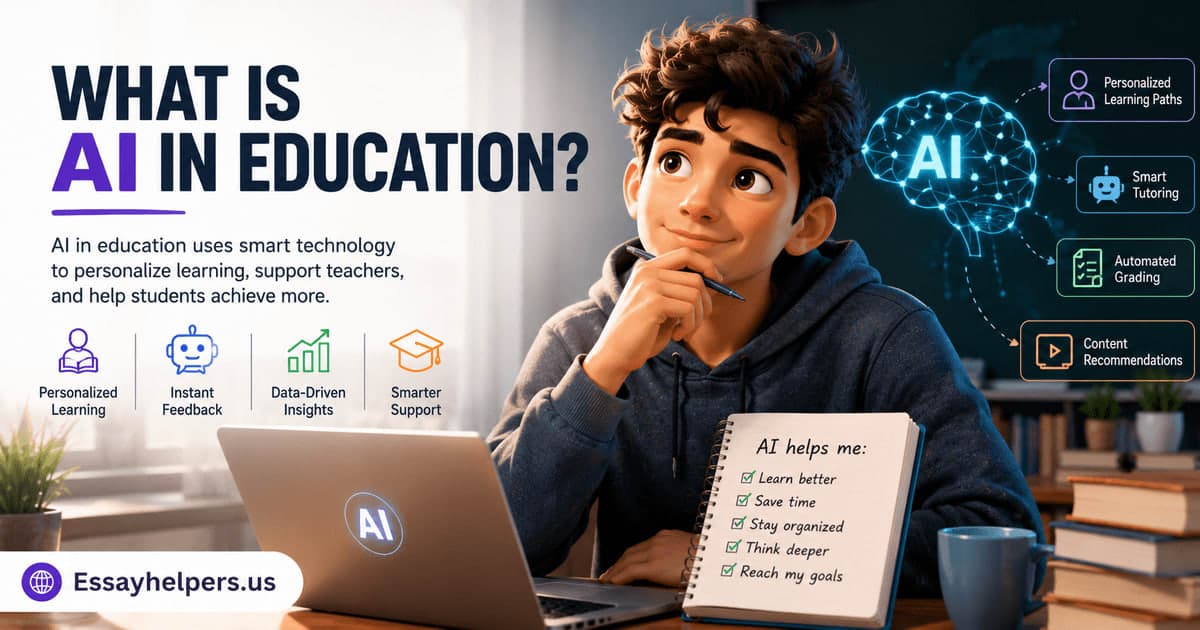
AI in education — also referred to as AIEd or artificial intelligence in education — is the application of artificial intelligence technologies to support and improve teaching, learning, and educational administration. This includes adaptive learning platforms that personalise content difficulty based on student performance, intelligent tutoring systems that provide real-time guidance, automated feedback tools that support writing and assessment, data analytics systems that help educators identify students at risk, and natural language processing tools that assist with reading and language development. The AI in education definition also encompasses the administrative layer: scheduling tools, progress tracking systems, and communication assistants that reduce the non-instructional load on teachers. Across all of these applications, EdTech powered by AI distinguishes itself from older EdTech by its ability to adapt — to the individual student, to the specific moment, to the data generated in real time. This is just one of the many benefits of AI in education.
AI in education does not replace the teacher. It does not guarantee better outcomes on its own. And it is not a single technology — it is a category of tools, each with specific applications, strengths, and limitations. The question is not whether AI in education is good or bad. The question is which tools, used in which ways, produce better outcomes for which students. That is a question teachers are better placed to answer than anyone else — provided they start from an accurate understanding of what is AI in education in the first place.
What AI in education looks like when it works
Now that we know what it means to heave AI in education, the next question is practical ways on how to use AI?
When AI in education works well, it is largely invisible to students. They experience a maths platform that gives them a problem that is just hard enough — not frustrating, not boring. They receive feedback on a draft essay that is specific enough to act on. They get a reading passage at a level that challenges them without shutting them down.
What teachers experience when AI in education works well is recovered time. A lesson plan that used to take forty minutes takes eight. A set of differentiated materials that used to require two hours of preparation is generated in ten minutes and edited in five. An exit ticket is analysed and summarised before the teacher has finished packing up the classroom.
The AI in education examples that produce these results are not experimental. Khan Academy's adaptive maths practice — one of the most-studied intelligent tutoring systems in the world — has been shown in independent research to accelerate student progress. AI-powered writing feedback tools have been shown to increase revision rates among students who would otherwise submit first drafts unchanged. Artificial intelligence in education, applied to formative assessment, has helped teachers intervene earlier with struggling students than traditional observation alone allows. These are documented AI in education examples with measurable outcomes, not projections.
That does not mean every EdTech tool works, or that artificial intelligence in education produces guaranteed results in every context. It means that when the right intelligent tutoring system or adaptive platform is applied to the right task — with a clear understanding of what it can and cannot do — the outcomes are real. For teachers building AI literacy for students, and for students developing their own AI literacy, the first step is understanding the AI in education definition accurately — which starts with putting the misconceptions behind you.
If your students need support with their academic work while you build your understanding of what is AI in education, Essay Helpers is available 24/7. Our team works with students across subjects and levels, so no student falls behind during the transition.
Want more topic updates?
Subscribe for new study resources, blog updates, and supporting cluster pages.
About the Author
Gregory D. Monroe
Ph.D. in Higher Education Administration, M.A. in Student Affairs