How does AI help students learn in maths, reading, writing, and more?
How does AI help students learn in maths, reading, writing, and more? We break down the research by subject in 2026 for you.
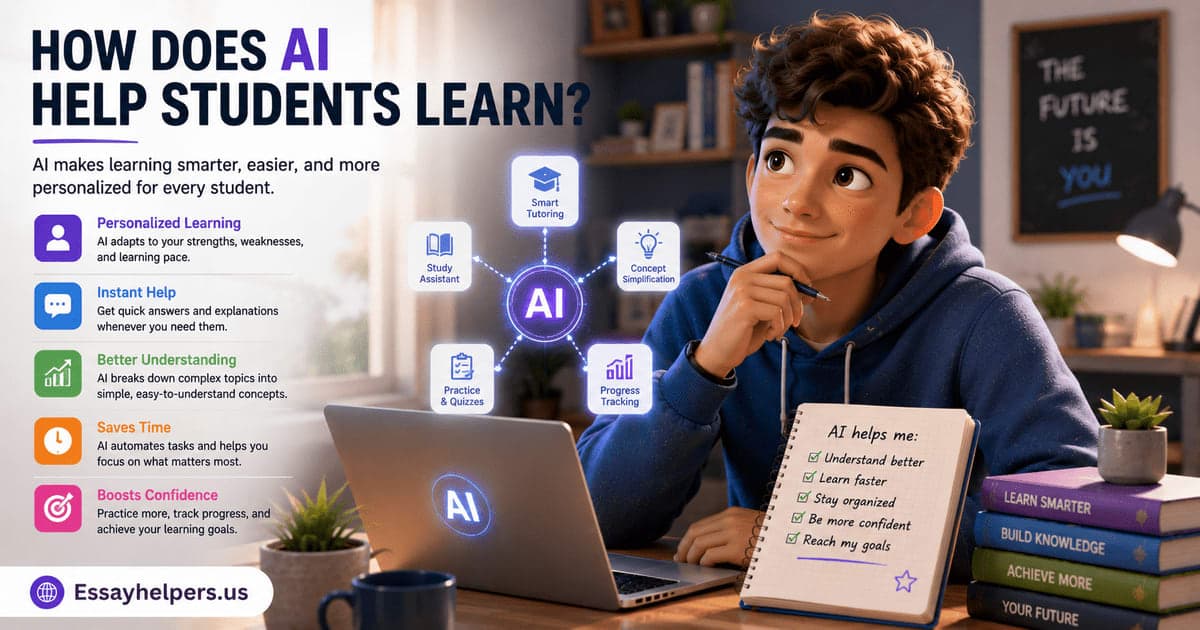
How does AI help students learn? or How to use AI in the classroom?
The honest answer is: it depends on the subject. AI tutoring systems that produce measurable gains in mathematics use fundamentally different mechanisms than AI writing tools for students — and both work differently from the AI tools that help students with language learning or science research. The statistics of AI in education shows the technology is here to stay
Understanding how AI helps students learn by subject gives teachers and parents a far more useful picture than any generic answer can. This guide is designed to answer how does AI help students learn with the specificity that question deserves.
This guide breaks down how AI helps students learn across five core subject areas, with the research behind each claim and the specific tools that deliver the strongest results in AI in K-12 education contexts. It also covers what is consistent across all subjects — and what AI still cannot do, regardless of the curriculum area.
Why AI helps students differently depending on the subject
The mechanisms by which AI helps students learn vary significantly by subject because the cognitive demands of each subject vary. Mathematics is a domain of structured, sequential knowledge — each concept builds on the last, and errors have clear, traceable causes. This makes it ideal for adaptive AI tutoring systems, which can identify exactly where a student's understanding breaks down and serve a targeted correction before the misconception compounds. Asking how does AI help students learn in maths is a different question from asking how does AI help students learn to write — and understanding the difference is what allows schools to match the right tools to the right subjects.
Writing, by contrast, is a domain of open-ended judgment. How does AI help students learn to write well? Not by identifying a single right answer, but by providing feedback on argument structure, evidence use, and clarity — tasks that require natural language understanding rather than pattern matching. The tools that work for mathematics are not the tools that work for writing, and the mechanisms are different in both cases.
Reading sits somewhere between the two: AI helps students learn to read through adaptive levelling and comprehension support, but the gains are most pronounced for students reading below grade level rather than advanced readers. Language learning is perhaps the area where AI tutoring systems have the most mature research base outside of mathematics — the structured, repetitive nature of vocabulary and grammar acquisition maps well onto what AI does best.
Understanding these differences is what allows teachers to deploy AI tools for students purposefully, matching the right tool to the right subject rather than assuming any one AI system will work across the curriculum.
Enhance your Academic Performance And Reach Your Goals
See how quick and easy it is to get an exceptional essay with minimal effort on our platform
How AI helps students learn maths
Mathematics is where the evidence for how AI helps students learn is strongest and most consistent. Adaptive learning platforms — the dominant category of AI tutoring systems in maths — have been studied since the 1990s, giving the field a research base that most other AI education applications lack.
The core mechanism: AI tutoring systems in mathematics track each student's response to every question and use that data to identify exactly where their understanding breaks down. A student who consistently makes sign errors in algebraic equations gets a different next task than a student who understands sign rules but struggles with factoring. This is how AI helps students learn maths in a way that whole-class instruction cannot — the precision of the diagnosis is simply not achievable at scale without AI.
Carnegie Learning's MATHia is the most extensively studied example of AI tutoring systems in action. A 2023 study found students using MATHia gained 11 percentile points more than matched peers over one academic year. Khan Academy's adaptive maths exercises — available free — show consistent gains for students using the platform for 30+ minutes per week. DreamBox Learning, targeting elementary and middle school mathematics, has shown statistically significant gains in multiple independent evaluations across diverse AI in K-12 education contexts.
The AI student learning outcomes in maths are also notable for struggling students specifically. Students who are significantly below grade level benefit disproportionately from AI tutoring systems — because the adaptive algorithm can take them back to the foundational gap without the social cost of being seen to work on "easy" content in front of peers.
This is one of the key benefits of AI in education. Also it is a genuine advantage of AI in K-12 education: it allows remediation to happen at pace and in private, with AI student learning outcomes that consistently outperform what whole-class remediation can achieve.
How AI helps students learn to read
Reading is the foundational skill on which all other academic progress depends, and AI tools for reading have developed significantly since 2020. How does AI help students learn to read — and how does it help already-reading students read better? The answer depends heavily on the student's current level.
For students reading below grade level — a group that includes a disproportionate share of AI for ESL students and students with learning disabilities — AI reading tools work primarily through levelled text adaptation and comprehension scaffolding. Platforms like Newsela use AI to adapt the same article to multiple reading levels, allowing struggling readers to access the same content as their peers without the barrier of inaccessible vocabulary. Diffit does the same for teacher-selected texts. These tools help students learn to read by keeping them in contact with meaningful content rather than simplified, low-interest materials that disengage them further. The AI in K-12 education research on reading consistently shows that time-on-text is one of the strongest predictors of reading growth — and AI tools increase time-on-text by removing the friction of inaccessible material.
For students reading at or above grade level, how AI helps students learn shifts from levelling to depth. Tools like CommonLit and Actively Learn use AI to generate discussion questions, annotation prompts, and comprehension checks calibrated to the specific text — pushing students to read more carefully rather than more slowly. AI literacy — the capacity to read and evaluate AI-generated content critically — is itself becoming a reading comprehension skill that these tools increasingly address, preparing students for an information environment where AI-generated text is ubiquitous.
The research on AI for reading is slightly less consistent than for maths, primarily because reading is harder to measure. But studies of Newsela use in K-8 classrooms show consistent gains in reading level and engagement, particularly for students who were previously disengaged from reading instruction. That is how AI helps students learn to read at the classroom level: by reducing the friction between student and text.
How AI helps students with writing
Writing is the area where teachers are most ambivalent about AI tools for students — and understandably so. The line between AI that helps students learn to write and AI that writes for students is genuinely blurry, and getting it wrong in either direction has real costs.
How does AI help students learn to write well, rather than just producing writing? What are the pros and cons of AI for students and teachers alike? The answer lies in the feedback loop.
AI writing tools for students like Khanmigo, Grammarly's feedback tools, and Turnitin's AI writing assistant are designed to respond to student drafts with questions and suggestions rather than rewrites. A student who writes a thesis statement that is too broad gets a prompt like "what specific aspect of this topic are you focusing on?" — not a replacement thesis. This is how AI helps students learn through writing: by making the revision process more responsive without bypassing the student's thinking. The best AI writing tools for students function as what writing researchers call "writing partners" — present throughout the process, responding to the student's ideas rather than replacing them.
The research supports this approach. Studies from Stanford's Graduate School of Education found that students using AI writing tools for students produced an average of 2.3 more revision cycles per assignment than control groups — and more revision correlates strongly with better final products. The AI student learning outcomes for writing are most pronounced when the tools are configured to ask questions rather than provide answers. AI literacy is also relevant here: students who understand how AI writing assistants work — what they are good at, what they miss, and where their suggestions should be questioned — use them far more effectively than students who treat AI output as authoritative.
For students who use AI to generate text and submit it as their own — the academic integrity concern — the research is also clear: the learning gains that come from writing practice do not transfer to students who bypass the process. AI writing tools for students produce genuine gains only when the student is still doing the thinking. Teachers who understand this distinction are better positioned to design writing tasks that make the distinction unambiguous.
Enhance your Academic Performance And Reach Your Goals
See how quick and easy it is to get an exceptional essay with minimal effort on our platform
How AI helps students learn a second language
Language learning is one of the oldest applications of AI tutoring systems, and one of the most mature in terms of both technology and research. How does AI help students learn a language? Through three primary mechanisms: spaced repetition for vocabulary, immediate pronunciation and grammar feedback, and conversational practice with a patient, always-available interlocutor.
Duolingo's AI-powered spaced repetition system — which schedules vocabulary review at precisely the intervals that maximise retention — has been shown in multiple studies to produce vocabulary gains equivalent to a semester of university instruction for dedicated users. For AI for ESL students specifically, the availability of AI language practice at any time and at any pace is transformative: a student who needs to practise English conversation has access to a tool that will respond to them without judgment, at any hour, for as long as they need. AI for ESL students removes the two biggest barriers to language practice: availability and anxiety.
Khanmigo's language tutoring features extend this into subject-specific English practice — helping AI for ESL students not just acquire conversational English but academic English, the register that matters most in AI in K-12 education settings. AI for ESL students in mainstream classrooms often involves supporting not just English acquisition but content comprehension simultaneously, and the most effective AI tutoring systems now address both dimensions at once. The AI student learning outcomes for language acquisition among ESL populations are among the most consistently positive in the entire AI in K-12 education research literature.
The AI student learning outcomes for language acquisition are among the best-evidenced in the entire AI education literature — partly because language learning is inherently measurable (vocabulary size, grammar accuracy, comprehension scores) and partly because the mechanisms AI uses — repetition, feedback, practice — are exactly what language acquisition research has always identified as most effective. AI tutoring systems simply deliver those mechanisms with more consistency and at greater scale than human instruction alone can manage.
How AI helps students with science and research skills
Science and research skills represent a newer frontier for how AI helps students learn. The tools are less mature, and the research base is thinner, but the direction is clear: AI is most useful in science education not for delivering content but for supporting scientific thinking — hypothesis formation, research design, data interpretation, and source evaluation.
For primary and middle school science, AI tutoring systems like Khan Academy's AI features help students understand concepts through adaptive questioning — working through a student's misconception about, say, how photosynthesis works by asking targeted questions rather than re-explaining the same way. For secondary and post-secondary students, AI research tools like Perplexity and Elicit help students navigate scientific literature — identifying relevant studies, summarising findings, and flagging conflicting evidence — tasks that previously required significant research training and that represent a new frontier in AI student learning outcomes.
AI literacy is central to science education in 2026 in a way it was not five years ago. Students who understand how AI summarises and sometimes misrepresents scientific consensus — and who can evaluate AI-generated science explanations critically — are better prepared for both academic and professional scientific work. Teaching AI literacy as part of science instruction is itself one of the clearest answers to how does AI help students learn: not by delivering content but by making the process of evaluating information more explicit and teachable. The AI in K-12 education research on science is still developing, but the direction is clear — AI tutoring systems that support inquiry outperform those that deliver content passively.
The AI in K-12 education research on science is still developing. What is clear is that AI tools that support inquiry — asking better questions, evaluating evidence more carefully, iterating on hypotheses — produce better learning outcomes than AI tools that deliver science content passively. How AI helps students learn science is, ultimately, about supporting the scientific process rather than shortcutting it.
What is consistent across all subjects
Across mathematics, reading, writing, language learning, and science, three things are consistently true about how AI helps students learn — and all three hold regardless of subject, tool, or student type.
First: AI helps students learn most when it increases the amount of practice they get at an appropriate level of challenge. This is true in maths (more adaptive practice via AI tutoring systems), in writing (more revision cycles through AI writing tools for students), in language (more conversational practice for AI for ESL students), and in reading (more time spent with levelled texts). The mechanism is practice volume — AI makes it possible to get more of it, and AI student learning outcomes across all subjects reflect this.
Second: AI helps students learn most when it provides feedback faster than a human teacher can. The gap between an error and a correction is one of the most important variables in learning. AI tutoring systems close that gap to seconds. Human feedback arrives in days. The AI student learning outcomes advantage in every subject reflects this timing difference — and it is why AI in K-12 education continues to expand even in schools with strong human teaching.
Third: how AI helps students learn is always conditional on the student still doing the thinking. AI tools that replace student effort — generating essays, solving equations, providing answers — produce no learning gains. AI tools that support student effort — prompting revision, identifying errors, asking questions, building AI literacy — produce consistent gains. The distinction is not between "AI" and "no AI." It is between AI used as a scaffold and AI used as a substitute.
For students who need additional support beyond what AI tools can provide — especially in the writing and research domains where human feedback remains hard to replicate, and for AI for special education students whose needs extend beyond what adaptive algorithms currently address — Essay Helpers is available 24/7 with subject-specific academic assistance across all curriculum areas. AI tutoring systems have transformed what is possible in K-12 learning, but the human expert remains irreplaceable for the most complex and nuanced academic challenges.
Want more topic updates?
Subscribe for new study resources, blog updates, and supporting cluster pages.
About the Author
Gregory D. Monroe
Ph.D. in Higher Education Administration, M.A. in Student Affairs