Pros and cons of AI in education: what the evidence actually says
What are the real pros and cons of AI in education? We pressure-test each claim including bias and academic integrity in 2026
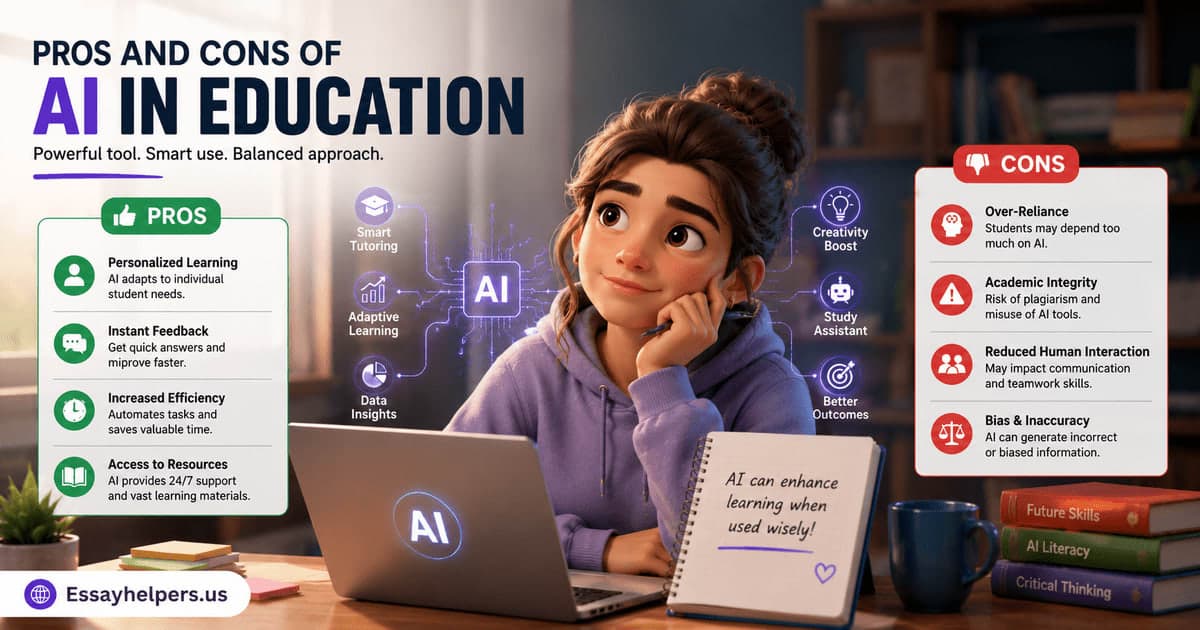
The pros and cons of AI in education get debated constantly — and badly. The pro side tends to overstate benefits with cherry-picked statistics. The con side tends to catastrophise based on edge cases and speculation. Neither approach helps educators make informed decisions about the real risks of AI in schools or the genuine advantages on offer.
This page takes a different approach. For each major pro and con of AI in education, we apply the same test: what does the evidence actually show, under what conditions, and with what caveats? The result is a more honest picture of the pros and cons of AI in education than most listicles provide — and a more useful one for anyone trying to figure out how to engage with AI in their school or classroom. The analysis also aims to verify practical ways of how to use AI in the classroom.
Whether you are weighing the AI education challenges of adoption or trying to understand the AI ethics in education debate, this breakdown starts from the evidence rather than the marketing.
Why the pros and cons of AI in education need evidence behind them
When educators evaluate the pros and cons of AI in education without evidence, they tend to default to either enthusiasm or fear — neither of which is a reliable guide to adoption decisions. Enthusiasm leads to purchasing tools that underdeliver. Fear leads to avoiding tools that would genuinely help students. Both extremes are common in the AI ethics in education debate, and both lead schools to poor decisions.
The research base on AI in education has matured significantly since 2020. There are now independent meta-analyses, randomised controlled trials, and longitudinal studies covering the major use cases. That evidence base addresses real AI education challenges — bias, data privacy, academic integrity — as well as the genuine benefits. It does not resolve every question, but it is substantial enough to separate what is known from what is speculated. That is what this breakdown attempts to do for each of the pros and cons of AI in education that matter most.
Enhance your Academic Performance And Reach Your Goals
See how quick and easy it is to get an exceptional essay with minimal effort on our platform
Pro 1: AI personalises learning — the reality
The claim: AI allows teachers to deliver personalised learning at scale, adapting content and difficulty to each individual student in a way that whole-class instruction cannot.
The reality: This pro is well-supported by the research — with important conditions attached. Adaptive learning platforms like Khan Academy, Carnegie Learning, and IXL use algorithms to identify where each student is on a learning progression and adjust the next task accordingly. A 2023 study by the Center for Research and Reform in Education found students using Carnegie Learning's MATHia gained 11 percentile points more than matched peers over one academic year. These are real gains, produced by real personalisation — and they represent one of the clearest advantages in any honest assessment of the pros and cons of AI in education.
The condition: the gains appear consistently only when students use the platform for meaningful amounts of time — typically 30 minutes or more per week — and when teachers are trained to interpret and act on the platform's data. Schools that deploy adaptive platforms without embedding them into instructional practice see much smaller effects. The AI education challenges here are not technical — the tools work — but organisational. The pro is real; the delivery conditions matter enormously.
Verdict on this pro: Supported by strong evidence, conditional on implementation quality. Among the most robust of all the pros and cons of AI in education.
Pro 2: AI saves teacher time — the reality
The claim: AI tools for lesson planning, grading, feedback, and parent communication save teachers significant preparation and administrative time each week.
The reality: This is one of the most consistently reported benefits across practitioner surveys. A 2024 Education Week Research Center survey found teachers using AI for lesson planning saved an average of 3.6 hours per week. Teachers using AI for report comments and parent communication saved an additional 1.2 hours. These are not trivial numbers — nearly five recovered hours per week represents a meaningful shift in how teachers can allocate their time.
The nuance: time savings are not evenly distributed. Teachers who receive training on how to prompt AI tools effectively report significantly larger savings than those who adopt tools without support. Teachers who attempt to use AI for tasks requiring deep contextual knowledge — nuanced student feedback, sensitive parent communication — often find that heavy editing erases the time benefit. The pros and cons of AI in education for teacher time are real, but they depend on which tasks the AI is being used for and how well the teacher has learned to use it. Understanding these AI education challenges upfront is what separates schools that realise the time savings from those that don't.
Verdict on this pro: Supported by consistent survey evidence, strongest for structured and repetitive tasks. A clear advantage on any honest pros and cons of AI in education assessment.
Pro 3: AI improves student outcomes — the reality
The claim: AI tools produce measurable improvements in student achievement, particularly for students who are behind grade level or who benefit from additional practice and feedback.
The reality: The evidence here is positive but sector-specific. The strongest AI education outcomes data covers three areas: adaptive maths and reading platforms, AI writing feedback tools that increase student revision rates, and predictive analytics that help schools intervene earlier with at-risk students. Georgia State University's implementation of an AI early warning system produced a documented 21% reduction in dropout rates over five years. These are significant outcomes.
The honest caveat: most of the strongest research covers platforms and systems that have existed for 10 or more years. The evidence base for generative AI tools — ChatGPT, Claude, Gemini used for student learning — is still forming. The pros and cons of AI in education for student outcomes are well-established for some tool categories and genuinely uncertain for others. Claims that generative AI will transform student achievement are ahead of the evidence. This is one of the most important AI education challenges for the field to address in the coming years: understanding which generative AI applications produce real academic gains and which produce only the appearance of learning. Until that research matures, this particular dimension of the pros and cons of AI in education should be treated with appropriate caution.
Verdict on this pro: Strong for established adaptive platforms; still emerging for generative AI tools. Proceed with evidence, not hype.
Enhance your Academic Performance And Reach Your Goals
See how quick and easy it is to get an exceptional essay with minimal effort on our platform
Con 1: AI threatens academic integrity — the reality
The claim: AI tools — especially generative AI — make it trivially easy for students to cheat, undermining the assessment systems schools rely on to measure genuine learning.
The reality: This is a real and serious con of AI in education, not a hypothetical. Generative AI tools can produce plausible essays, solve maths problems with working shown, and generate responses that closely mimic student writing. AI detection tools exist but are imperfect — they produce false positives, flag non-native English speakers disproportionately, and are routinely circumvented by students who understand their limitations. AI academic integrity is now a genuine operational challenge for every school and university that uses written assessments. The risks of AI in schools on this dimension are not theoretical — they are being managed in real time by admissions offices, faculty boards, and academic integrity committees across the country.
The important context: this con is real, but the response to it matters as much as the con itself. Schools that respond by banning AI entirely face a compliance problem — students use it anyway — and miss the opportunity to build AI literacy for students who will need it professionally. Schools that redesign assessments to require personal, specific responses — in-class drafts, process portfolios, presentations — find that the AI academic integrity threat is much more manageable. The risks of AI in schools around academic integrity are significant, but they are addressable through assessment design more effectively than through prohibition. This is one of the clearest AI education challenges that has a known and teachable solution.
Verdict on this con: Genuine and significant, but manageable through assessment redesign rather than prohibition.
Con 2: AI is biased and inequitable — the reality
The claim: AI systems reproduce and amplify existing biases in education, making them harmful to students from already marginalised groups.
The reality: This con is also real, documented, and serious — but more nuanced than it is often presented. Research has shown that some AI writing assessment tools penalise non-standard English dialects, producing lower scores for African American students whose writing reflects dialect-specific grammatical conventions. Some predictive analytics systems have been shown to over-flag students of colour as at-risk based on demographic correlates rather than genuine behavioural signals. AI bias in education is not theoretical — it is measured in peer-reviewed studies, and the disadvantages of AI in education in this area fall disproportionately on already marginalised student populations.
The nuance: AI bias in education is a function of how tools are designed, trained, and monitored — not an inherent property of AI itself. Adaptive learning platforms that have been carefully validated across diverse student populations show much more equitable outcomes than AI assessment tools trained on non-representative datasets. The risks of AI in schools around bias are real, but they are concentrated in specific tool types and are addressable through careful procurement, independent auditing, and ongoing outcome monitoring disaggregated by student group. AI data privacy in schools intersects with this concern too — tools that collect extensive student data create additional exposure for the same populations who are already most vulnerable to bias-driven harm.
Verdict on this con: Genuine and documented, concentrated in specific tool categories, addressable through rigorous procurement and monitoring.
Con 3: AI replaces meaningful teacher-student relationships — the reality
The claim: As AI takes over more teaching functions — tutoring, feedback, instruction — the human relationships at the core of good education are eroded, with long-term harm to students' social and emotional development.
The reality: This con is the most speculative of the three, and the evidence is the thinnest. There is no robust longitudinal research showing that appropriate AI use in classrooms reduces the quality of teacher-student relationships. What the research does show is that teachers who use AI to reduce administrative burden report spending more time in direct student interaction — the opposite of the feared outcome.
The legitimate version of this concern is narrower: AI tools used as a substitute for human interaction — replacing teacher feedback with AI feedback entirely, replacing tutoring with AI tutoring entirely — do represent a meaningful con of AI in education and a genuine AI ethics in education concern. The disadvantages of AI in education in relationship quality are real in this specific deployment model. AI tools used as a complement to human instruction, freeing time for teachers to be more present, do not carry this risk. The risks of AI in schools around relationship quality are real only in specific deployment contexts, not as a general property of AI in education. This distinction — between AI as substitute and AI as supplement — is at the heart of most responsible AI ethics in education frameworks.
Verdict on this con: Speculative in general form; real in specific deployment contexts where AI substitutes for rather than supplements human interaction.
Pros and cons of AI in education: side-by-side summary
For readers who want a fast reference before the detailed breakdown, here is the full picture of the pros and cons of AI in education at a glance. This table summarises the evidence-based verdict on each major pro and con covered in this page.
| **Pros of AI in education** | **Evidence strength** | **Cons of AI in education** | **Evidence strength** |
| Personalised learning at scale | Strong (multiple RCTs) | AI academic integrity risks | Strong (documented, real) |
| Teacher time savings | Strong (survey data) | AI bias in education | Strong (peer-reviewed) |
| Improved student outcomes | Strong (established platforms) | AI data privacy in schools | Moderate (policy concern) |
| Earlier identification of at-risk students | Strong (longitudinal data) | Relationship quality erosion | Weak (speculative in general) |
| Improved equity and access | Mixed (tool-dependent) | Disadvantages of AI in education for under-resourced schools | Mixed (access gap exists) |
The pros and cons of AI in education are not symmetrical in their strength of evidence. The pros have a deeper and more consistent research base — particularly for adaptive learning platforms and teacher workload tools. The cons are real but more variable: AI academic integrity and AI bias in education are strongly evidenced concerns; risks of AI in schools around relationship quality are more speculative. This asymmetry matters when schools are making adoption decisions. The risks of AI in schools are mostly manageable. The disadvantages of AI in education are mostly avoidable. The AI education challenges are mostly known. What is required is the institutional will to ask the right questions before committing to any tool.
Schools that treat the pros and cons of AI in education as a checklist to run through before adoption — rather than a debate to win — are the ones that tend to implement well and see genuine returns. The pros and cons of AI in education are, ultimately, a map of the conditions under which AI in education works and the conditions under which it does not.
Verdict: how to weigh the pros and cons of AI in education
The pros and cons of AI in education, taken together, form a picture not of a technology that is inherently good or bad but of a set of tools whose outcomes are almost entirely determined by how they are chosen, deployed, and monitored. The pros are real and well-supported for specific tools in specific contexts. The cons are also real and should not be dismissed — but they are mostly addressable through thoughtful implementation rather than avoidance. That is the honest conclusion that the weight of evidence on the pros and cons of AI in education most clearly supports. And it is a more actionable conclusion than either uncritical enthusiasm or blanket rejection of the pros and cons of AI in education debate.
The pros and cons of AI in education do not resolve into a simple answer of "AI is good" or "AI is bad." They resolve into a set of procurement, deployment, and monitoring questions that schools need to ask and answer for each tool they consider. Which students will this serve? What evidence supports its outcomes for those students? How will we monitor for AI bias in education? How will we protect AI academic integrity? What will teachers need to use this effectively? What will AI data privacy in schools require us to put in place? What AI education challenges are we most likely to encounter, and how will we respond? What AI ethics in education principles will guide our decisions when outcomes are ambiguous?
Schools that ask these questions before adoption are better positioned to realise the pros and manage the cons. The disadvantages of AI in education — AI bias in education, AI academic integrity risks, AI data privacy in schools exposure, relationship erosion in substitution-mode deployments — are not inevitable. They are the predictable result of adoption without adequate planning. Schools that treat the risks of AI in schools as manageable design challenges, rather than reasons to avoid or accept AI uncritically, tend to land in a much better place. Schools that adopt without asking them tend to experience the cons more acutely and the pros less reliably.
If students at your school need academic support while their teachers and administrators are navigating this landscape — managing AI academic integrity concerns, monitoring for AI bias in education, addressing AI data privacy in schools requirements, and working through the real AI education challenges of adoption — Essay Helpers is available 24/7. The pros and cons of AI in education are complex enough that every school benefits from human-backed, subject-specific support that fills the gaps AI tools cannot, and that is exactly what our team provides.
Want more topic updates?
Subscribe for new study resources, blog updates, and supporting cluster pages.
About the Author
Gregory D. Monroe
Ph.D. in Higher Education Administration, M.A. in Student Affairs