Benefits of AI in education: what the research actually shows
What are the real benefits of AI in education? We break down 5 research-backed advantages with the evidence behind each.
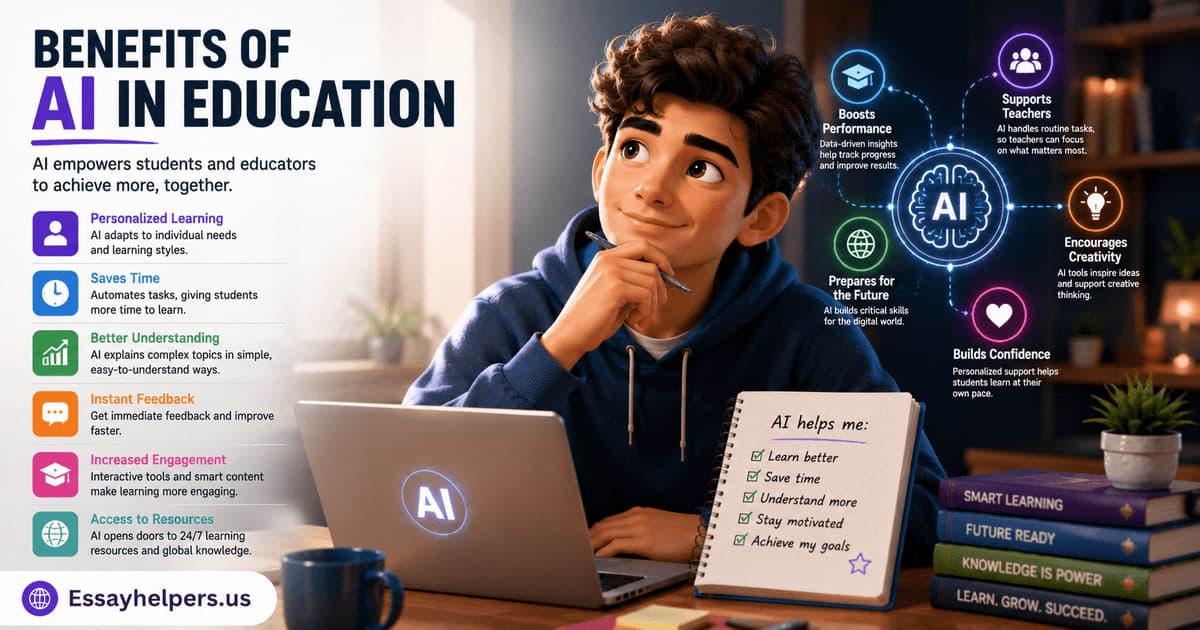
The benefits of AI in education are discussed constantly — in policy documents, conference talks, and vendor marketing. What gets discussed far less often is the evidence behind those claims. This page takes a different approach. For each major benefit of AI in education, we look at what the research actually shows, where the evidence is strong, and where it is still developing. The goal is not to sell the advantages of AI in education but to give educators and administrators an accurate picture of what the data supports — so they can make adoption decisions based on AI education outcomes rather than enthusiasm.
What does the research say about AI in education outcomes?
The research base for AI education outcomes has grown significantly since 2020. The field now includes randomised controlled trials, large-scale longitudinal studies, and independent meta-analyses — not just vendor case studies. The picture that emerges is nuanced: the benefits of AI in education are real and measurable in specific contexts, but they are not universal or automatic. This matters because the benefits of AI in education are often presented in absolute terms — as guaranteed improvements — when the data tells a more conditional story.
The strongest evidence base for AI education outcomes sits in three areas: adaptive learning platforms for mathematics and reading, AI-assisted feedback on writing, and early identification of at-risk students through predictive analytics. In each of these areas, multiple independent studies show consistent positive effects on AI student success metrics. Data-driven teaching — using AI-generated data to inform instructional decisions — has also shown consistent benefits in contexts where teachers receive training on how to interpret and act on the data. The advantages of AI in education are also well-supported in personalised instruction contexts, where adaptive platforms outperform static materials on both engagement and AI and student achievement metrics. The evidence is thinner — but growing — in areas like AI teaching assistants, automated grading, and generative AI for student research.
What the research does not support is the idea that any AI tool, deployed in any context, produces the benefits of AI in education automatically. Implementation quality, teacher training, and alignment between the tool and the learning objective all moderate AI education outcomes significantly. The benefits of AI in education are real when the conditions are right — and understanding those conditions, including how AI improves learning in specific subject areas and with specific student populations, is what separates effective adoption from expensive disappointment. The advantages of AI in education documented in the research are not a ceiling — they are a floor for what well-implemented AI student success programmes can achieve.
Enhance your Academic Performance And Reach Your Goals
See how quick and easy it is to get an exceptional essay with minimal effort on our platform
Benefit 1: Personalised learning at scale — the evidence
Personalised instruction has long been recognised as one of the most effective approaches in education. Bloom's 1984 "2 sigma" study showed that students receiving one-to-one tutoring performed two standard deviations above those in conventional classroom instruction. The problem was always scale: no school system can provide every student with a personal tutor. This is why the benefits of AI in education in the personalised learning category are so significant — and why the benefits of AI in education overall are often anchored to this particular use case first. AI platforms are the first realistic attempt to deliver something close to one-to-one personalised instruction at whole-class scale.
AI-powered adaptive learning platforms are the most serious attempt yet to close that gap. Platforms like Khan Academy, IXL, and Carnegie Learning use algorithms to identify where each student is on a learning progression and adjust the next task accordingly. A student who gets a concept right three times in a row gets a harder problem. A student who makes the same error type repeatedly gets a different explanation before trying again.
The AI education outcomes data on these platforms is strong. A 2023 study by the Center for Research and Reform in Education found that students using Carnegie Learning's MATHia platform for one academic year gained 11 percentile points more than matched peers in traditional instruction — a significant AI and student achievement gap closed through personalised instruction alone. A 2022 evaluation of Khan Academy use in US middle schools found statistically significant gains in maths achievement for students using the platform for at least 30 minutes per week.
The benefit here is not just better outcomes — it is better AI education outcomes without requiring schools to hire more staff or reduce class sizes. How AI improves learning in the personalised instruction category is fundamentally about scaling what was previously unscalable. The advantages of AI in education in the personalised learning category scale in a way that human-only approaches cannot. Personalised instruction delivered by AI does not get tired, does not run out of time, and does not treat the thirty-second student differently from the first.
Benefit 2: Faster, more specific student feedback — the evidence
Feedback is one of the most powerful influences on learning outcomes in the research literature. Hattie and Timperley's landmark 2007 meta-analysis, covering 196 studies, found feedback to be among the top ten influences on student achievement — with an effect size of 0.73, well above the typical educational intervention. The problem is not that teachers do not know this. It is that meaningful written feedback on student work takes time that most teachers do not have. One of the clearest benefits of AI in education is that it closes this gap — giving students the high-frequency, specific feedback that research says matters, at a speed no human teacher can match alone.
AI-assisted feedback tools address this directly. Tools like Turnitin's AI feedback assistant and EssayGrader provide students with specific, actionable comments on argument structure, evidence use, and writing mechanics within seconds of submission. Research on automated writing evaluation tools consistently shows that students who receive immediate AI feedback are more likely to revise their work than students who wait for teacher feedback — and revision frequency is one of the strongest predictors of writing improvement. The benefits of AI in education here accrue to both students and teachers simultaneously.
The advantage of AI in education for feedback is not that it replaces the teacher's judgment. It is that it moves the revision process earlier — students engage with feedback before submission rather than after a grade has been returned, when motivation to revise drops sharply. Studies from Stanford's Graduate School of Education found that students using AI writing feedback tools produced an average of 2.3 more revision cycles per assignment than control groups. The AI student success benefit compounds: more revision means better final products, which means higher AI and student achievement on the tasks that matter most.
Data-driven teaching is made more powerful by this feedback loop too. When AI tools log the specific error patterns across a class's writing submissions, teachers gain a diagnostic picture of what the whole class needs — not just individual students. That aggregated data supports more targeted personalised instruction than any individual teacher could produce from reading 30 essays alone. This is how AI improves learning at the class level, not just the individual level: by surfacing patterns that would otherwise stay invisible.
Benefit 3: Reduced teacher workload — what studies show
Teacher workload is a documented crisis in US education. The RAND Corporation's 2023 State of the American Teacher survey found that 77% of teachers reported frequent job-related stress — with administrative tasks, lesson planning, and marking identified as the top time drains. The link between workload and attrition is well established: teachers who report unsustainable workloads are significantly more likely to leave the profession within five years. The benefits of AI in education for teacher retention are therefore inseparable from the benefits for teacher workload — and both deserve serious attention from school leadership.
The benefits of AI in education for teacher workload are among the most consistently reported in practitioner surveys. A 2024 survey by the Education Week Research Center found that teachers using AI tools for lesson planning reported saving an average of 3.6 hours per week on preparation tasks — time that can be reinvested in personalised instruction and one-to-one student support. Teachers using AI for report writing and parent communication reported saving an additional 1.2 hours per week.
These are not trivial numbers. Nearly five hours per week recovered from administrative tasks is time redirected toward the highest-value parts of teaching — personalised instruction, one-to-one student support, and data-driven teaching conversations with colleagues. The advantages of AI in education for teacher sustainability matter not just for individual teachers but for the system: every teacher retained is a year of accumulated expertise and data-driven teaching knowledge that does not have to be rebuilt. AI student success, in this framing, depends partly on teacher stability — and the benefits of AI in education for workload directly support that stability.
The research also shows that workload reduction benefits are not evenly distributed. Teachers who receive training in how to use AI tools effectively report significantly larger time savings than those who adopt tools without support. This is a consistent finding across all benefit categories: the benefits of AI in education are amplified by implementation quality, and diminished by poor onboarding.
Enhance your Academic Performance And Reach Your Goals
See how quick and easy it is to get an exceptional essay with minimal effort on our platform
Benefit 4: Early identification of at-risk students — the data
One of the least-discussed but most impactful benefits of AI in education is predictive analytics — the use of data to identify students who are at risk of falling behind before they actually do. Traditional early warning systems rely on attendance records, grade reports, and teacher observation. These are lagging indicators: by the time a student shows up as at-risk in a traditional system, they have often already disengaged. The benefits of AI in education in this category are about shifting from reactive to proactive — a fundamental change in how schools protect students who are slipping through the cracks.
AI-powered early warning systems analyse a broader and more current set of signals: assignment completion rates, time-on-task data from digital platforms, response patterns in formative assessments, and engagement metrics from learning management systems. These systems can flag a student as potentially at-risk within days of a change in behaviour pattern — weeks before a grade decline would show up in a traditional report. The data-driven teaching capability this enables — acting on AI education outcomes data in near real-time rather than at the end of a term — is one of the most significant operational advantages of AI in education for school leadership teams.
Research on predictive analytics in education is consistently positive on AI student success outcomes. A study from Georgia State University — which implemented an AI early warning system across its undergraduate programmes — found a 21% reduction in dropout rates over five years, with the largest gains among first-generation college students. A 2022 study in K-12 contexts found that schools using AI early warning systems intervened with at-risk students 6.4 weeks earlier on average than schools using traditional methods — time that translates directly into better AI education outcomes.
The advantages of AI in education in this area are particularly important from an equity perspective. Students from low-income backgrounds, students with learning disabilities, and English language learners are disproportionately represented in dropout and failure statistics. Early identification — enabled by AI — allows schools to target support where it is needed most, rather than waiting for a crisis. Data-driven teaching, at its most powerful, is teaching that catches students before they fall — and the AI and student achievement gains from early intervention consistently outperform those from remediation after the fact.
A more detailed advantages and disadvantages of using AI in education is provided as well in our post 'Pros and cons of AI in education: what the evidence actually says'.
Benefit 5: Improved equity and access — what the research shows
The fifth major benefit of AI in education is also the most contested: the claim that AI tools improve equity and access in education. The evidence here is genuinely mixed, and intellectual honesty about the benefits of AI in education requires presenting both sides.
On the positive side, AI tools for personalised instruction give students in under-resourced schools access to high-quality adaptive learning that would otherwise require specialist tutors or small class sizes. AI translation and language support tools improve access for English language learners in ways that scaling human interpretation services cannot match. AI-powered accessibility features — text-to-speech, reading level adaptation, alternative format generation — reduce barriers for students with disabilities faster and more cheaply than manual accommodation processes. These advantages of AI in education for access are among the most equitable applications of the technology, and how AI improves learning for historically underserved students is one of the field's most important active research questions.
The AI student success case for equity is further supported by data-driven teaching approaches that disaggregate outcome data by student group in real time. Schools using AI analytics platforms can see — often for the first time — which interventions are producing AI education outcomes for which students, and which are not. That transparency is itself a benefit of AI in education: it makes inequity visible in ways that aggregate reporting does not.
The advantages of AI in education for access are real in these specific applications. How AI improves learning for students who would otherwise be underserved — through adaptive personalised instruction, language support, and accessibility tools — is one of the more compelling arguments for adoption in districts with limited resources. AI student success, in this framing, is not just about high performers getting more challenge. It is about students who have historically been left behind getting the consistent, responsive support that only AI can deliver at scale.
The counterpoint — important and also research-supported — is that AI tools can reproduce and amplify existing biases if trained on biased data. Studies have shown that some AI writing assessment tools penalise non-standard English dialects. Some predictive analytics systems over-flag students of colour as at-risk based on demographic correlates rather than genuine behavioural signals. These are not hypothetical concerns. They are documented in peer-reviewed literature.
The honest summary: the benefits of AI in education for equity are achievable but not guaranteed. They require deliberate attention to bias in tool selection, ongoing monitoring of AI education outcomes disaggregated by student group, and a willingness to discontinue tools that produce inequitable results. The advantages of AI in education should mean better outcomes for all students — and the research makes clear that the benefits of AI in education in equity contexts require active management, not passive adoption.
What the research doesn't yet tell us
Intellectual honesty about the benefits of AI in education requires acknowledging the gaps and the AI in education statistics. The evidence base for generative AI tools in education — ChatGPT, Claude, Gemini — is still forming. Most of the strongest research covers adaptive learning platforms and intelligent tutoring systems, which have been studied for decades. The benefits of AI in education from generative AI are plausible and in some cases anecdotally well-supported, but the rigorous longitudinal data does not yet exist at the same scale.
Similarly, the long-term effects of AI-assisted personalised instruction on student independence and self-regulated learning are not well understood. If students learn primarily in environments that adapt to them, do they develop the resilience and problem-solving capacity needed for environments that do not? This is an open research question — and one that educators implementing AI tools should keep in mind.
None of this undermines the benefits of AI in education that are well-evidenced. The advantages of AI in education in personalised instruction, feedback, workload reduction, early intervention, and data-driven teaching are real, replicated, and practically significant. Understanding where the benefits of AI in education are strongest — and where the evidence is still developing — is what allows schools to make adoption decisions that produce genuine AI student success rather than just AI activity. The best practitioners will treat AI tools as part of an evidence-informed approach to data-driven teaching rather than as complete solutions, monitoring AI education outcomes closely and adjusting when the evidence says to. For students who need additional academic support alongside whatever AI tools their school is adopting, Essay Helpers is available 24/7 — a human-backed service that fills the gaps even the most well-evidenced AI student success tools cannot.
Want more topic updates?
Subscribe for new study resources, blog updates, and supporting cluster pages.
About the Author
Gregory D. Monroe
Ph.D. in Higher Education Administration, M.A. in Student Affairs