AI in education statistics 2026: numbers every educator needs to know
The most important AI in education statistics: adoption rates, student usage, and teacher attitudes — all in one place.
Still wondering how to use ai in the classroom?
AI in education statistics 2026 tell a story that is more nuanced than either the optimists or the skeptics tend to present. Adoption is accelerating. Generative AI student usage is widespread. The AI teacher adoption rate is positive but training-dependent. AI education research on outcomes is strong in specific contexts and still unproven in others. The EdTech AI market is growing faster than almost any other segment of the education industry — the EdTech AI market growth trajectory is documented in the AI education market size projections suggesting the sector will nearly quadruple by 2030.
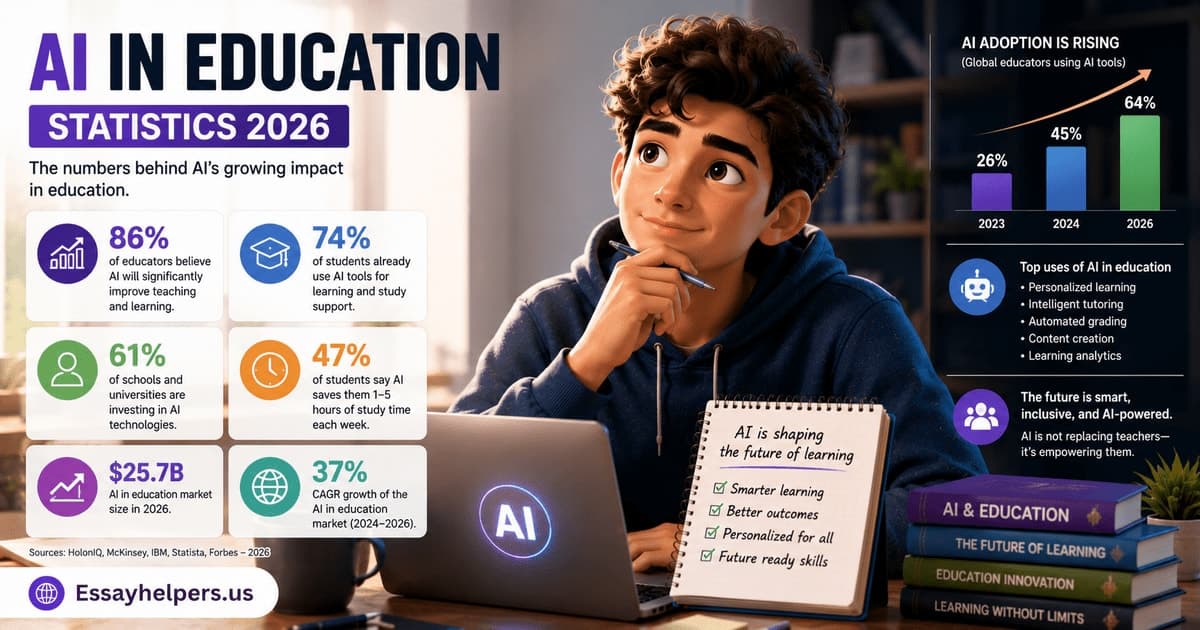
This page collects the most important AI in education statistics 2026 across six categories — adoption, generative AI student usage, outcomes, teacher attitudes, AI education market size, and equity — with sources for every figure. It is updated for 2026 and will be reviewed again in early 2027. Whether you are tracking AI in education trends 2026, preparing a presentation, writing a policy document, or simply trying to understand where AI in education actually stands right now, these are the AI in education statistics 2026 you need.
AI adoption in US schools — 2026 statistics
The AI teacher adoption rate has accelerated significantly since 2023, driven primarily by the widespread availability of free and low-cost generative AI tools and the expansion of district-level AI policies. These AI in education statistics 2026 on adoption represent the clearest evidence that AI in education trends 2026 are not hype — they are measurable, documented, and accelerating. The benefits of AI in education are broad.
According to the 2025 EdWeek Research Center Survey on AI in Schools, 56% of US teachers reported using AI tools in their professional practice at least once per month — up from 31% in 2023 and 18% in 2022. The AI teacher adoption rate growth over three years is one of the most rapid in the history of EdTech AI market adoption. Among teachers who use AI regularly, lesson planning is the most common use case, cited by 72% of regular AI users. Formative assessment generation is second at 58%, and parent communication third at 41%.
At the district level, AI in K-12 statistics show that 43% of US school districts had adopted a formal AI use policy by the start of the 2025–2026 academic year — compared to just 12% in the 2023–2024 year. The rapid policy expansion reflects both the pressure of student generative AI use and the growing recognition that prohibition-only approaches are unenforceable. These AI in K-12 statistics on policy adoption are one of the most significant AI in education trends 2026 for administrators to track.
For higher education, AI adoption statistics are even higher. A 2025 EDUCAUSE survey found that 78% of US college faculty had used AI tools for at least one professional task in the prior academic year — course design, grading assistance, research, or student communication. Only 14% reported using AI with students in a structured, pedagogically intentional way, highlighting a significant gap between personal AI teacher adoption rate and classroom integration that the AI education research community is actively studying.
Key AI in K-12 statistics at a glance:
- 56% of US teachers use AI tools monthly (EdWeek 2025) — a core AI in education statistics 2026 benchmark
- 43% of US districts have a formal AI policy (COSN 2025)
- 78% of US college faculty have used AI professionally (EDUCAUSE 2025)
- 14% of faculty use AI with students in a structured way (EDUCAUSE 2025)
- 89% of districts report that student AI use outpaced district policy in 2024 (COSN 2025)
Enhance your Academic Performance And Reach Your Goals
See how quick and easy it is to get an exceptional essay with minimal effort on our platform
AI student usage statistics 2026
Generative AI student usage statistics are among the most striking in the entire AI in education statistics 2026 landscape — and among the most consequential for academic integrity policy. The generative AI student usage data tells a clear story: students adopted AI for schoolwork faster than any school system anticipated, and the AI in education statistics 2026 on this dimension have driven most of the policy urgency at district and university level.
A 2025 Tyton Partners survey of US students in grades 6–12 found that 73% of middle and high school students had used a generative AI tool for schoolwork at least once in the prior academic year. Among high school seniors specifically, the figure was 86%. These generative AI student usage figures are consistent across multiple independent surveys and represent one of the most reliable data points in the AI in education statistics 2026 landscape. Usage is highest for writing assistance (64% of AI users), research and summarisation (58%), and maths problem solving (41%).
At the college level, generative AI student usage is near-universal among certain demographics. A 2025 Inside Higher Ed survey found that 92% of US college students had used AI for at least one academic task — with essay drafting (71%), research assistance (66%), and exam preparation (54%) as the top use cases. The AI in K-12 statistics on unsanctioned use are particularly relevant for school administrators. The same Tyton Partners survey found that 51% of students who used AI for schoolwork reported doing so without their teacher's knowledge — and 29% reported using AI in ways they believed their teacher would not permit if asked. These AI in education statistics 2026 on unsanctioned use are a clear signal that policy without pedagogy is insufficient.
Thus the need to understand the pros and cons of AI in education is ever more crucial.
Key student usage statistics at a glance (AI in education statistics 2026):
- 73% of grades 6–12 students used generative AI for schoolwork in 2024–25 (Tyton Partners)
- 86% of high school seniors used AI for academic tasks (Tyton Partners 2025)
- 92% of US college students used AI for at least one academic task (Inside Higher Ed 2025)
- 51% of student AI users did so without teacher knowledge (Tyton Partners 2025)
- 38% of college students received clear institutional guidance on AI use (Inside Higher Ed 2025)
AI impact on student outcomes — what the data shows
So, how does AI help students learn?
AI education research on student outcomes is the area where the data is most rigorous and most frequently misrepresented. The AI in education statistics 2026 on outcomes are positive — but conditional. Understanding this conditionality is the most important single insight the AI education research base offers to practitioners and policymakers in 2026.
For adaptive learning platforms in mathematics, the evidence is strong. Carnegie Learning's MATHia showed an 11 percentile point gain over one academic year versus matched controls in a 2023 peer-reviewed study — one of the most-cited figures in the AI education research literature. Khan Academy's internal AI education research shows consistent gains for students using adaptive maths practice for 30+ minutes per week. DreamBox Learning has shown statistically significant gains across 14 independent evaluations.
For AI writing feedback tools, the AI education research shows clear gains in revision behaviour. Students using AI writing feedback tools produced an average of 2.3 additional revision cycles per assignment versus control groups (Stanford GSE, 2024). For predictive analytics, the Georgia State University implementation showed a 21% reduction in undergraduate dropout rates over five years. Across all AI education research on outcomes, one finding is consistent: implementation quality is the strongest moderator. These AI in education statistics 2026 on outcomes are most meaningful when read alongside the training and policy data — because the numbers only materialise when the conditions are right.
Key outcome statistics (AI in education statistics 2026):
- +11 percentile points in maths: MATHia vs matched controls (Carnegie Learning / CRRE 2023)
- +2.3 revision cycles per assignment: AI writing feedback vs control (Stanford GSE 2024)
- -21% undergraduate dropout rate: AI early warning system over 5 years (Georgia State)
- Students using Khan Academy 30+ min/week show consistent maths gains (Khan Academy Research)
- Implementation quality is the #1 moderator of AI education research outcomes (multiple sources)
Teacher attitudes toward AI in education — 2026 survey data
The AI teacher adoption rate data tells one story. Teacher attitude data tells another — and the two are not always consistent. The AI in education statistics 2026 on teacher attitudes reveal a workforce that is broadly open to AI but significantly under-supported in adopting it well. This gap between the AI teacher adoption rate and training provision is one of the defining AI in education trends 2026 that district leaders need to address.
The 2025 RAND State of the American Teacher survey found that 61% of teachers believe AI tools have the potential to meaningfully improve their professional practice. However, only 34% felt adequately trained to use AI tools effectively — a gap that directly predicts adoption quality. Teachers who reported feeling adequately trained were 3.2 times more likely to use AI tools regularly than those who did not. This training-adoption multiplier is the most actionable single finding in the AI teacher adoption rate data for district decision-makers.
On academic integrity, 79% of teachers identified student misuse of AI as a significant concern — the highest-rated concern in the entire RAND survey. The most striking finding in recent AI in education statistics 2026 on training is the self-direction gap: only 19% of teachers received formal professional development on AI from their school or district. The remaining 81% learned independently. This self-directed AI teacher adoption rate produces highly variable outcomes and represents one of the largest structural gaps in the current AI in education trends 2026 landscape.
Key teacher attitude statistics (AI in education statistics 2026):
- 61% of teachers believe AI can meaningfully improve their practice (RAND 2025)
- 34% of teachers feel adequately trained to use AI effectively (RAND 2025)
- 79% of teachers identify student AI misuse as a significant concern (RAND 2025)
- 19% of teachers received formal AI professional development from their district (EdWeek 2025)
- Trained teachers are 3.2× more likely to use AI regularly (RAND 2025)
Enhance your Academic Performance And Reach Your Goals
See how quick and easy it is to get an exceptional essay with minimal effort on our platform
AI in education market size and growth statistics
The EdTech AI market statistics represent some of the most cited figures in the AI in education statistics 2026 landscape — and some of the most variable, depending on methodology and scope. The AI education market size projections vary significantly across research firms, but the directional consensus is clear: the EdTech AI market is in a sustained growth phase with no signs of plateauing.
The most widely cited AI education market size figure comes from HolonIQ's 2025 Global Education Technology Report, which estimated the global AI in education market at $6.1 billion in 2024, projected to reach $23.8 billion by 2030 — a compound annual growth rate of approximately 25.4%. The North American market accounts for approximately 38% of global EdTech AI market spending — the largest single regional share.
Within the US specifically, the EdTech AI market statistics show that district spending on AI-enabled tools increased by 47% in the 2024–2025 academic year compared to the prior year. The AI education market size growth in this specific segment — institutional K-12 purchasing — is the most reliable indicator of sustained sector investment, as it reflects budget-cycle commitments rather than pilot spending. Venture investment in AI education startups reached $4.2 billion globally in 2024 — a record high in the EdTech AI market — with US-based companies receiving approximately 52% of total global investment. These AI in education statistics 2026 on market activity signal that the EdTech AI market will continue to expand regardless of policy debates, driven by institutional and venture capital commitments already in place.
Key market statistics (AI in education statistics 2026):
- $6.1 billion: global AI in education market size, 2024 (HolonIQ)
- $23.8 billion: projected global AI in education market size, 2030 (HolonIQ)
- 25.4%: projected CAGR for the global EdTech AI market 2024–2030
- 47%: increase in US district AI tool spending, 2024–2025 (EdWeek Research Center)
- $4.2 billion: global venture investment in AI education startups, 2024 (HolonIQ)
AI in higher education statistics 2026
AI in higher education statistics 2026 show a sector moving faster on AI adoption than K-12 — but with more significant gaps between institutional policy and student practice. The AI in education statistics 2026 for higher education are characterised by high personal adoption, low structured integration, and a policy landscape that is still catching up to generative AI student usage.
The EDUCAUSE 2025 Horizon Report found that 91% of institutions had either adopted or were actively developing an AI strategy by the start of 2025. Only 34% had implemented student-facing AI policies that clearly defined acceptable use. Faculty attitudes show that 67% believe AI will require significant assessment redesign within three years, but only 28% feel confident about how to do it. The AI in education statistics 2026 for higher education paint a picture of an institution that knows change is coming but has not yet built the capacity to lead it. AI education research on higher education outcomes remains thinner than for K-12 — the Georgia State dropout study remains the gold standard — but this is an active area of EdTech AI market investment.
The AI in education trends 2026 on equity are among the most important in the statistics landscape. On access, the EdTech AI market expansion of free tools has reduced barriers significantly. The AI education market size of free-tier tools — Khan Academy, Duolingo, Brisk Teaching — has grown substantially, reaching Title I school populations at scale. However, a 2025 Pew Research Center report found that students from higher-income households were 1.6 times more likely to use AI for enrichment than lower-income peers. And 44% of rural district students report limited or no access to school-recommended AI tools (COSN 2025). These AI in education statistics 2026 on equity do not support blanket optimism or pessimism — they support tool-specific, data-monitored adoption decisions that track disaggregated outcomes. The AI in education statistics 2026 are, ultimately, a call for evidence-based practice: the numbers show what is possible when AI is implemented well, and what goes wrong when it is not.
Want more topic updates?
Subscribe for new study resources, blog updates, and supporting cluster pages.
About the Author
Gregory D. Monroe
Ph.D. in Higher Education Administration, M.A. in Student Affairs