Can ChatGPT do ALEKS? I tested it so you don't have to
Can ChatGPT do ALEKS? Learn where AI tools fail, why ALEKS adaptive format is different, and what works instead in 2026.
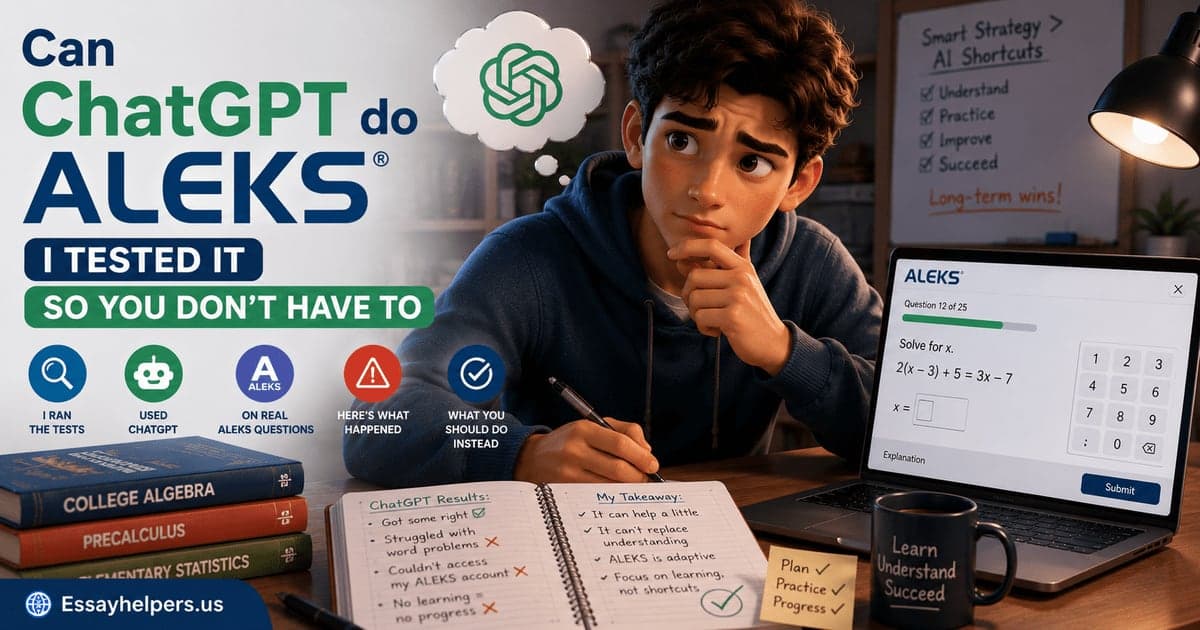
The honest answer is: partially, in a limited way, with significant caveats — and not in any way that actually solves the problem you're trying to solve. Can ChatGPT do ALEKS? Not in the way most students hope.
If you're asking because you're behind on ALEKS and you're hoping a large language model can close the gap, this post will save you the time of finding out the hard way. If you're asking out of genuine curiosity about what AI can and can't do on an adaptive learning platform, it's actually an interesting question with a specific technical answer.
Either way, the answer isn't "yes" or "no" — it's structural. The reason ChatGPT can't do ALEKS isn't a matter of intelligence or capability in the general sense. It's a matter of how ALEKS is built and what completing it actually requires. Understanding that structure also explains why every AI ALEKS solver you'll find advertised online fails the same way, regardless of which model it runs on.
If you're behind on ALEKS and need to close a topic gap before your next Knowledge Check, the Essay Helpers team has subject specialists who can work through your specific topics with you — no AI shortcuts, no detection risk.
The straightforward answer: what ChatGPT can and can't do on ALEKS
ChatGPT can do the following with ALEKS-style content: explain mathematical concepts, walk through worked examples of standard problem types, check your reasoning on a problem you paste into the chat, and help you understand why a particular method works the way it does.
That's genuinely useful. If you're stuck on how stoichiometry conversions work and you want a clear explanation with an example, ChatGPT can deliver that. If you want to understand why the quadratic formula produces two solutions, ChatGPT can explain it clearly. Used as a study companion, it has real value for ALEKS students.
What ChatGPT cannot do: access the ALEKS platform, read your specific questions, navigate the ALEKS interface, submit answers on your behalf, or pass a Knowledge Check in your name. It has no session access, no interface integration, and no ability to interact with anything inside your ALEKS account.
This is the gap between what students imagine when they ask "can ChatGPT do ALEKS" and what the technology actually makes possible. The question assumes ChatGPT can operate inside the platform. It can't. It can only respond to content you manually copy out of it and paste into a chat window — and that workflow has its own serious limitations, which the sections below explain.
Its better to use your time to find strategies to finish ALEKS topics faster.
Enhance your Academic Performance And Reach Your Goals
See how quick and easy it is to get an exceptional essay with minimal effort on our platform
Why ALEKS's adaptive format breaks AI solvers at the structural level
The core reason AI tools fail on ALEKS isn't that they're not smart enough to solve math problems. It's that ALEKS doesn't present static problems.
ALEKS generates questions algorithmically, adjusting the topic, difficulty, and variable values in real time based on your current knowledge state. Two students in the same course taking the same topic assessment will receive structurally similar questions — same concept, same method required — but different numerical values, different compound names, different variable configurations.
This adaptive generation means there is no fixed set of questions to solve in advance. An AI tool that could theoretically answer every ALEKS question ever asked would still be useless for your specific session, because your specific questions don't exist until you're inside the platform taking them.
The workflow students attempt when asking "can ChatGPT do ALEKS" in practice is: screenshot or copy a question from ALEKS, paste it into ChatGPT, read the answer, enter it into ALEKS. This works sometimes — for straightforward calculation problems where the method is clear and the answer is a single number. It fails in several predictable ways for everything else. The sections below cover each failure point specifically.
There's also a timing issue. ALEKS logs the time between question display and answer submission. A student who is copying questions into a separate chat window, waiting for a response, and then entering the answer will show anomalous response times — too slow for a student who knows the material, too inconsistent to look like natural problem-solving. That pattern is visible in the activity log any instructor can pull.
Can ChatGPT solve ALEKS math problems — the honest capability assessment
For pure calculation problems with a single numerical answer — basic algebra, stoichiometry with clear unit conversion, standard statistics calculations — ChatGPT performs reasonably well. It gets the method right most of the time and produces a correct answer for simple question structures.
The accuracy degrades in predictable ways as complexity increases:
Multi-step problems with intermediate rounding. ALEKS has specific significant figure and rounding rules that vary by course configuration. ChatGPT applies standard mathematical rounding, which frequently differs from ALEKS's expected answer format. A student who gets the chemistry right but rounds to the wrong decimal place gets the question marked incorrect. ChatGPT doesn't know your course's rounding rules and has no way to find out.
Conceptual and identification questions. Chemistry functional group identification, geometry proof steps, statistical interpretation questions — these require pattern recognition or reasoning about a specific presented scenario, not calculation. ChatGPT can engage with these if you describe the question accurately in text, but accurately describing a structural chemistry diagram or a geometry figure in text is time-consuming, error-prone, and slower than just solving the problem with a textbook.
Questions with embedded images or diagrams. A significant portion of ALEKS questions — particularly in chemistry, geometry, and trigonometry — include diagrams, molecular structures, or graphical data. These can't be copy-pasted as text. Taking a screenshot and uploading it to a vision-capable model like GPT-4o is possible, but adds steps, slows the workflow dramatically, and still doesn't solve the rounding or format mismatch problem.
The honest capability assessment: ChatGPT can help a student who already understands the material check their work. It cannot reliably replace the understanding itself — and for ALEKS specifically, replacing the understanding creates the Knowledge Check problem described in the next section.
Why ChatGPT can't pass an ALEKS Knowledge Check
This is the structural failure that makes the AI shortcut route ultimately unworkable for ALEKS, even for students who successfully use ChatGPT to move their pie forward in Learning Mode.
ALEKS Knowledge Checks are designed to verify that previously learned topics are genuinely retained. The platform compares your Knowledge Check performance against your Learning Mode progress. A student who completed 60 topics in Learning Mode — regardless of how — is expected to demonstrate understanding of those topics when the Knowledge Check asks about them.
ChatGPT cannot sit a Knowledge Check for you. Knowledge Checks are time-pressured, session-locked assessments that ALEKS administers inside the platform. You can't pause, copy questions to an external tool, wait for answers, and re-enter them within the response time parameters without producing the exact timing anomalies that activity log reviews flag.
More fundamentally: if you used ChatGPT answers to complete your Learning Mode topics without actually understanding the methods, your Knowledge Check score will not reflect your pie progress. The Knowledge Check will reveal the gap. Your pie will drop back. Your instructor will see a Learning Mode completion rate that doesn't match your Knowledge Check performance — the clearest single signal in the ALEKS activity log that something about the progress wasn't earned.
This is not a theoretical risk. It is the predictable outcome of using an AI tool to substitute for understanding rather than support it. The Knowledge Check is ALEKS's verification mechanism. It exists specifically to catch borrowed performance.
Enhance your Academic Performance And Reach Your Goals
See how quick and easy it is to get an exceptional essay with minimal effort on our platform
Does ALEKS detect AI tool use — open tabs, browser flags, session monitoring
ALEKS does not use browser lockdown software by default. It does not prevent you from opening other tabs, accessing external websites, or using AI tools in a separate window during a session. In that narrow sense, it does not "detect" AI tool use the way a proctored exam with Respondus or Honorlock would.
What ALEKS does detect — through the activity log, not through browser monitoring — is the behavioural pattern that AI-assisted sessions produce.
Response time anomalies are the primary signal. A student solving ALEKS problems without external help produces response times that vary naturally with problem difficulty — faster on familiar topics, slower on harder ones. A student copying questions into ChatGPT and waiting for responses produces a flatter, slower response time distribution with unusual pauses that don't correlate with question difficulty. That pattern is readable in session data.
Secondary signals include session timing that doesn't match the student's established engagement pattern, and topic completion velocity that exceeds what normal learning speed would produce. Neither of these individually triggers an investigation. Together, especially when a Knowledge Check regression follows, they make the activity log review uncomfortable to explain.
The practical answer to "does ALEKS detect AI tool use" is: not directly, but the session behaviour that AI-assisted work produces is visible to anyone who looks at the data.
What AI ALEKS solver tools actually are — and why they fail the same way
A search for "AI ALEKS solver," "can ChatGPT do ALEKS," or "ALEKS answers AI" returns a range of advertised tools — browser extensions, subscription services, and AI-powered platforms claiming to solve ALEKS problems automatically.
Most of these tools fall into one of two categories. The first is a wrapper around a general-purpose LLM — ChatGPT, Gemini, or a similar model — with a custom prompt that formats the output to look more like an ALEKS answer. These tools have exactly the same limitations as using ChatGPT directly, just with an extra subscription fee. They cannot access the ALEKS platform, cannot handle image-based questions without manual upload, and cannot address the rounding and format mismatch problem.
The second category is browser automation tools that claim to interact directly with the ALEKS interface — filling in answers automatically based on OCR or screenshot analysis. These tools are technically more ambitious but practically less reliable. ALEKS's interface updates regularly, breaking automation scripts. OCR misreads are common enough on mathematical notation to produce incorrect answers. And the session timing these tools produce is the most anomalous of all, since automated clicking produces inhuman response speed patterns that are immediately readable in the activity log.
Neither category solves the Knowledge Check problem. The pie may move. The verification check will not pass.
Tools, hacks, cheats, and shortcuts alone are not the reason why most students fail in ALEKS, other factors may apply, as indicated in this post.
What works instead: human subject knowledge vs. AI shortcuts on ALEKS
The consistent pattern across every AI-based ALEKS shortcut is the same: it can move the pie, it cannot build the understanding, and ALEKS's Knowledge Check system is specifically designed to tell the difference.
What actually works for students who are behind on ALEKS and need to close a topic gap quickly is the same thing that has always worked: someone who understands the subject explaining it clearly enough that you understand it too.
That's not a slow path. A subject specialist who knows ALEKS chemistry, algebra, or statistics — and who knows how the specific topic types ALEKS tests are structured — can move a student from genuine confusion to genuine competence on a topic block in two focused sessions. The resulting pie progress holds up in Knowledge Checks because it reflects real understanding, not borrowed answers.
ChatGPT can support that process usefully — as a concept explainer, a worked example generator, a patient question-answerer when you're working through material on your own. Used that way, it's a strong supplement. Used as a substitute for understanding, it creates exactly the inconsistency ALEKS is built to catch.
The Essay Helpers team works with students on ALEKS subject content directly — not as a completion service, but as subject-specialist support that builds the understanding you need to pass the Knowledge Checks on your own. If you're behind and your next check is coming up fast, reach out now.
Want more topic updates?
Subscribe for new study resources, blog updates, and supporting cluster pages.
About the Author
Jonathan Avery
Ph.D. in Instructional Design, B.S. in Education