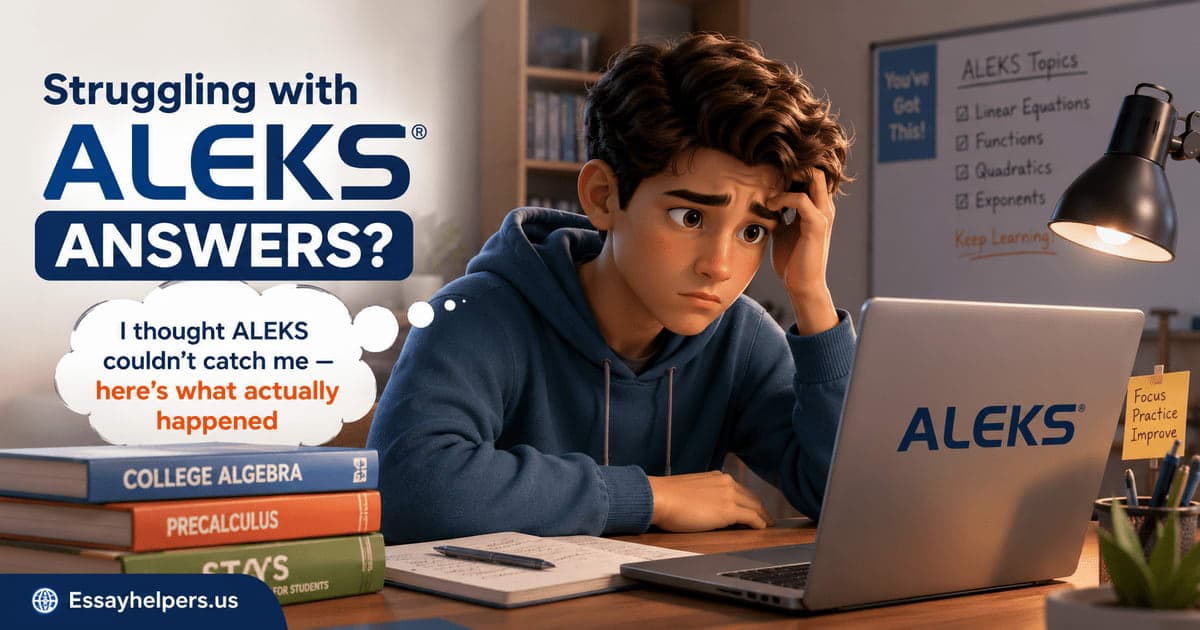
I thought ALEKS couldn't catch me — here's what actually happened
ALEKS tracks more than you think. Learn what instructors can see, how activity logs work, and the risks for students.
The email arrived on a Thursday morning. Short subject line. My professor's name in the sender field.
I knew before I opened it.
Three weeks earlier I'd made a decision that felt low-risk at the time. I'd been behind on my ALEKS coursework, a Knowledge Check was coming up fast, and I'd convinced myself the platform wasn't sophisticated enough to flag what I was doing. I'd searched "does ALEKS detect cheating" once, found a few vague forum posts saying it probably didn't, and decided that was good enough.
It wasn't.
If you're asking the same question right now — whether ALEKS can catch you, does ALEKS detect cheating through data alone, or what happens if it does — this is the honest answer. Not a forum guess. Not a Reddit thread from 2021. What actually happened to a student who found out the hard way. And if you're already worried you've been flagged, the Essay Helpers team can help you figure out your next move before things escalate.
Do not drop the ball yet like this guy, there is still time to get professional help.
What getting caught on ALEKS actually looks like
It doesn't start with a dramatic accusation. That's the part most students don't expect.
There's no pop-up warning. No immediate system lock. Nothing during the session that tells you something's wrong. You finish your Knowledge Check, close the tab, and go about your day thinking it went fine.
The signal comes later — and it comes from your instructor, not the platform.
In my case, it was a meeting request sent through the university portal. Polite wording. "I'd like to discuss your recent ALEKS activity." That phrase. The kind of language that means the conversation has already happened without you.
By that point, the decision had already been made somewhere. My professor had reviewed something, flagged something, and formed a conclusion. The meeting wasn't an investigation. It was a notification.
That's what getting caught on ALEKS actually looks like. Not a siren. A calendar invite.
Enhance your Academic Performance And Reach Your Goals
See how quick and easy it is to get an exceptional essay with minimal effort on our platform
ALEKS cheating consequences: what your institution can do
The consequences aren't set by ALEKS. The platform doesn't issue penalties. It generates data — and your institution decides what to do with it.
What that means in practice depends on where you study and how seriously your school treats academic integrity violations. At most US colleges and universities, a first offence results in at minimum: a formal written warning added to your academic file, a zero on the assessed work in question, and a mandatory meeting with an academic integrity officer.
More serious cases — especially where there's evidence of repeated behaviour or intentional deception — can escalate to course failure or academic suspension. Some institutions have a one-strike policy. Others use a tiered system. Either way, the outcome goes on your record, and that record follows you.
For students on academic probation already, or those in competitive programmes where grade thresholds matter for progression, a single ALEKS cheating consequence can derail a semester entirely. The aleks cheating consequences don't stop at a warning — I know one student who lost her nursing programme placement over it. Not because she failed a quiz — because the integrity violation disqualified her from a clinical placement requirement.
The platform itself didn't expel her. The data it produced gave her institution the grounds to act.
How it started: the signals ALEKS sent before I knew anything was wrong
Here's what I didn't understand at the time: ALEKS doesn't need to catch you in the act. It builds a picture over time.
The platform runs a continuous comparison between your Learning Mode performance and your Knowledge Check results. It tracks how long you spend on each topic, which topics you complete versus skip, and how your scores shift between assessed sessions. Normal learning has a recognisable pattern. So does cheating.
When your Knowledge Check score jumps significantly above what your Learning Mode engagement would predict — when you suddenly demonstrate mastery of topics you've barely touched in practice — the system flags that inconsistency. Not as proof that ALEKS can detect cheating. As a pattern worth reviewing. And that's when the question of what happens if you get caught cheating on ALEKS stops being hypothetical.
That review is where instructors come in.
Most ALEKS instructors have access to a detailed activity log for every student in their class. It shows session times, topic progression, time-per-question averages, and score history across every assessed period. An experienced instructor can look at that log and see, reasonably clearly, whether a student's performance is consistent with how they've been engaging with the material.
Mine could. And did.
Can ALEKS detect cheating without proctoring? (yes — here's how)
This is the question behind most of the forum posts you'll find. And the answer surprises a lot of students.
Does ALEKS detect cheating without Respondus Monitor, Honorlock, or any proctoring software? Yes — through data analysis alone. The same principle applies whether you're attempting an ALEKS placement test cheat or cutting corners on a standard homework module: the activity log captures the pattern either way.
The platform doesn't need to watch you through a webcam to identify suspicious patterns. It watches your data. Specifically:
Time-per-question anomalies. If you're answering complex algebra or stoichiometry problems in 8–12 seconds consistently, that's not normal. Average time for a student working through a problem they understand is closer to 60–180 seconds. When every question in a session runs under 20 seconds, it shows up.
IP address inconsistency. If your session logs show activity from two different locations simultaneously, or if your usual session location changes abruptly mid-course, that's a flag. It doesn't prove anything by itself — but combined with score inconsistencies, it becomes part of a pattern.
Knowledge Check regression. The most reliable signal. A student who scores high on one Knowledge Check and then significantly lower on the next — particularly when the second check was completed without external help — creates a clear inconsistency. ALEKS is designed around the assumption that real learning builds and holds. Borrowed performance doesn't hold.
None of these automatically triggers a formal investigation. But they do trigger a closer look from whoever's monitoring your course progress.
If you might be thinking that new technologies such as AI can help you cheat on Aleks, you might want to reconsider that by reading this blog post on whether "Can ChatGPT do ALEKS?"
Enhance your Academic Performance And Reach Your Goals
See how quick and easy it is to get an exceptional essay with minimal effort on our platform
The activity log review: what my professor found and when
My professor pulled my activity log after my second Knowledge Check came in lower than my first.
She didn't need anything beyond that. The log showed everything: my Learning Mode session times were short and inconsistent with the topic difficulty level. My first Knowledge Check score was significantly higher than my practice engagement justified. My second check — which I'd taken honestly because I was scared after the first one — dropped back to where my actual understanding was.
That gap told the story without me saying a word.
She cross-referenced it with my quiz submission times. My first Knowledge Check had an average response time of 14 seconds per question. My second was 97 seconds. For the same subject level. That's not a gap that comes from trying harder. It's a gap that comes from using external help in one session and not the other.
I found out later that she'd flagged two other students in the same class using the same method. She wasn't looking for trouble. She was doing a routine progress review and the data made it obvious.
That's the part most students underestimate. Instructors don't need to suspect you specifically. They just need to look at the numbers.
What happens next if you're already worried you've been flagged
If you're reading this after the fact — after a Knowledge Check that didn't go the way it should have, or after wondering whether ALEKS can detect cheating based on what you did — here's the honest picture.
You don't know yet whether your instructor has looked at your log. Many don't check unless there's a clear performance anomaly. If your scores have been consistent and your session times look normal, there may be nothing to worry about.
But if you're genuinely concerned, the worst thing you can do is nothing.
The second-worst thing you can do is try to cover it by performing differently on the next assessment without actually knowing the material. A sudden change in session behaviour — much longer response times, a very different accuracy pattern — can itself look unusual if it doesn't match any change in your practice engagement.
The best position to be in is one where your next Knowledge Check reflects real understanding. Not because it removes what happened before, but because it shows genuine progress. Instructors who are watching for patterns are also watching for genuine improvement. A student who clearly starts putting in the work, even late, is in a different position than one who doesn't.
That's where professional ALEKS help actually makes a difference — not as a shortcut, but as a way to catch up fast enough to legitimately change your performance before things escalate. Reach out to the Essay Helpers team and get matched with a subject specialist who can work through your specific ALEKS topics with you, not for you.
How to avoid being in this position in the first place
The simplest version: don't look for shortcuts that involve submitting work or answers you didn't produce. Still not convinced?
Read this blog on how ALEKS adaptive learning system beats every shortcut, Aleks cheats, or Aleks hacks.
The slightly more useful version: if you're behind on ALEKS and panicking, get help that builds real knowledge instead of substituting for it. The platform is designed to verify understanding repeatedly over time. A shortcut that works once creates a bigger problem the next time — because now you have a score you have to maintain without the knowledge behind it.
There are students who use ALEKS homework help legitimately. A tutor or subject specialist who explains how to actually solve the type of problem in front of you — who works through the concept so you understand it, not just the answer — is completely different from submitting work that isn't yours.
The distinction matters practically, not just ethically. Understanding does ALEKS detect cheating is one thing — but knowing the academic integrity cost before you're sitting across from an advisor is another. One path leads to an email from your professor. The other leads to a Knowledge Check you can actually pass on your own.
If these options are not for you, there is another solution that can guarantee you the results you want. Its simple pay someone to do your ALEKS.
Want more topic updates?
Subscribe for new study resources, blog updates, and supporting cluster pages.
About the Author
Jonathan Avery
Ph.D. in Instructional Design, B.S. in Education