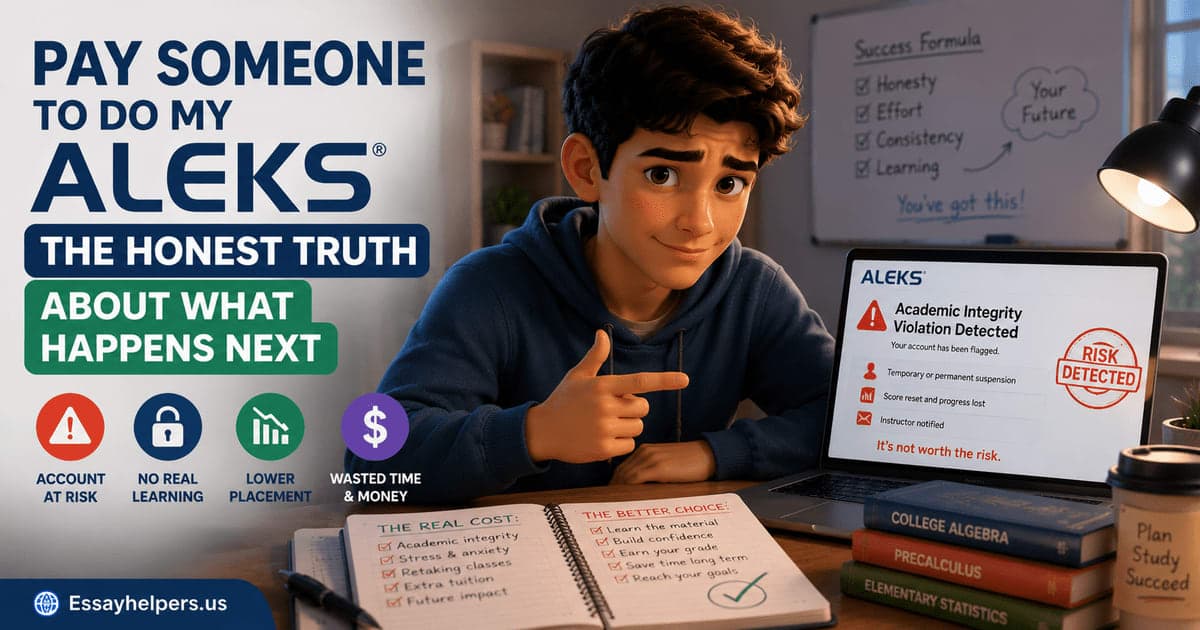
Pay someone to do my ALEKS: the honest truth about what happens next
Anonymous completion services, freelance tutors, or subject experts? See what each delivers and where risks lie, stay safe
If you've reached the point where you're searching "pay someone to do my ALEKS," you're probably not in a casual browsing mood.
You're behind. The pie looks impossible from where you're sitting. This leads you are in a similar situation where you are looking for ALEKS answers. A Knowledge Check is coming up and your practice engagement has been inconsistent at best. You've done the math on how many topics you'd need to complete per day to catch up legitimately, and the number doesn't work.
Hiring someone feels like the only option that gets the problem solved before the deadline.
Here's what most students don't get at that point: there isn't one type of ALEKS help-for-hire service. There are three — and they carry completely different risk profiles, deliver different outcomes, and leave you in very different positions when your next Knowledge Check arrives. Before you hand over payment details to the first service you find, this breakdown will tell you exactly what each option actually gets you. And if you want to skip straight to the one that doesn't leave you exposed, the Essay Helpers team is ready to match you with a subject specialist today.
Three types of services that come up when you search "pay someone to do ALEKS"
When students search "pay someone to do my ALEKS" or "hire someone to do my ALEKS," the results fall into three categories. They look similar on the surface — most advertise fast turnaround, guaranteed completion, and discreet service. What they actually offer, and what they actually risk, is very different.
Understanding the difference before you pay matters. Once the work is submitted and the pie starts moving, you're already in the outcome. There's no way to undo a completion pattern that ALEKS has logged.
The three types: anonymous ALEKS completion services, freelance tutors, and subject-specialist academic help. Each one is worth understanding in full before you decide.
Enhance your Academic Performance And Reach Your Goals
See how quick and easy it is to get an exceptional essay with minimal effort on our platform
Option 1 — Anonymous ALEKS completion services: what they offer and what they risk
These are the services that appear at the top of most "pay someone to do my ALEKS," "do my ALEKS homework," or "take my ALEKS test for me" searches. They typically advertise something like: "ALEKS expert completes your coursework — fast, guaranteed, confidential."
What they actually offer: A person — usually unverified — logs into your ALEKS account using your credentials and completes topics on your behalf. They work through your pie, pass Knowledge Checks where possible, and hand back an account with more progress than when they started. Some services complete the entire course. Others work topic-by-topic or section-by-section.
What they cost: Prices vary widely. Full-course completion services typically run 150 - 400. Per-section or per-Knowledge Check services are cheaper but add up quickly over a full course.
What they actually risk: This is where the gap between the marketing and the reality is widest.
ALEKS logs every session in detail — login location, time-per-question averages, topic completion rate, and Knowledge Check score trajectory. When someone else completes your ALEKS work, these patterns change in ways that are difficult to disguise. An anonymous service worker completing 40 topics in a three-hour session produces a very different activity log than a student working through the same topics over two weeks of normal engagement.
The more significant risk is the Knowledge Check regression pattern. ALEKS runs periodic Knowledge Checks to verify that previously learned topics are retained. A student who had 80% of their pie completed by an anonymous service — but who genuinely understands 30% of the material — will fail a retention Knowledge Check. That failure drops the pie back, creates a visible inconsistency in the activity log, and signals to any instructor doing a routine review that the progress wasn't earned.
Anonymous services also carry a credential risk that the other two options don't. Handing your login details to an unverified third party means giving a stranger full access to your institutional email, your student portal, and in some cases your financial aid account. There are documented cases of account compromise through ALEKS completion services. That risk is entirely separate from the academic integrity exposure.
Bottom line on Option 1: High immediate convenience. High detection risk. No knowledge gained. Credential security risk. The pie moves — but so does your exposure.
Option 2 — Freelance tutors: better, but with their own limitations
The second category is freelance tutors — individuals advertising ALEKS help on platforms like Fiverr, Upwork, or through college tutoring boards. These range from genuine subject-matter experts to students offering peer help at low rates.
What they actually offer: This varies significantly by the individual. The best freelance tutors explain concepts, work through problems with you, and help you understand the material. The worst do exactly what anonymous services do — complete your work for you — just with slightly more personalised interaction.
What they cost: Hourly rates typically run 20 - 80 depending on subject level and platform. For ALEKS chemistry or calculus-level work, expect the higher end. For algebra or statistics, rates tend to be lower.
What they actually risk: The risk depends almost entirely on how the tutor works. A freelance tutor who explains the material and helps you solve problems independently carries almost no detection risk — because your sessions produce natural performance data. A freelance tutor who does the work for you while you watch carries the same detection risk as Option 1, just with more overhead.
The practical limitation of freelance tutoring for ALEKS specifically is matching. ALEKS is adaptive — the topics you need help with depend on your current knowledge state, your course configuration, and the specific gap areas your pie has identified. A general math tutor who doesn't know ALEKS's structure may not be able to target your actual gaps efficiently. You can spend three sessions with a competent algebra tutor and still not move the specific ALEKS topics that are blocking your pie progress.
Bottom line on Option 2: Variable quality. Low risk if the tutor teaches rather than completes. Higher cost-per-outcome than Option 3 for ALEKS-specific help because of the matching problem. Can be highly effective with the right person — but finding the right person through a general freelance platform takes time most students at this point don't have.
Option 3 — Subject-specialist academic help: what legitimate support looks like
The third category is subject-specialist help from a service that specifically works with ALEKS students — where a verified expert in your subject area works through your specific topic gaps with you, explains the concepts, and gets you to a point where you can pass the Knowledge Check on your own.
What they actually offer: This is structurally different from the other two options. You're not paying for someone to complete your coursework. You're paying for someone who knows your subject deeply to help you understand it fast enough to complete it yourself. The work submitted to ALEKS is yours. The knowledge behind it is real.
What they cost: Rates for this type of help typically run 30 - 80 per session depending on subject level and session length. For students who need targeted help on specific topic blocks — stoichiometry, organic chemistry, trigonometry — a focused two-to-three session engagement often covers the gap.
What they actually risk: Near zero, because the performance pattern in ALEKS reflects genuine learning. A student who works with a chemistry specialist for two sessions and then completes their stoichiometry topics will produce session data that looks exactly like a student who learned stoichiometry — because they did.
The Knowledge Check that follows is also passable. A student who genuinely understood the material in the session can demonstrate that understanding independently. The pie progress holds. The score doesn't collapse on the next retention check.
What it requires from you: Engagement. You can't be passive in these sessions and expect the outcome to stick. The specialist explains the method; you work the problems. That's the exchange. Students who show up distracted or expecting to watch rather than participate get less out of it. Students who show up and engage — even at the basic level of following along and asking questions — typically see meaningful topic movement within the first session.
Bottom line on Option 3: No detection risk. Knowledge that holds up in Knowledge Checks. No credential exposure. Requires genuine engagement. This is what the Essay Helpers team provides — reach out and get matched with a specialist in your subject area today.
Enhance your Academic Performance And Reach Your Goals
See how quick and easy it is to get an exceptional essay with minimal effort on our platform
Is it safe to pay someone to do ALEKS? Comparing risk across all three
Put the three options side by side and the risk profile becomes clear.
Anonymous completion services carry the highest risk. Session data inconsistency, Knowledge Check regression, credential exposure, and zero retained knowledge. The pie moves. Everything downstream gets harder.
Freelance tutors sit in the middle. If they teach, the risk is low. If they complete, the risk is the same as Option 1. The problem is you often don't know which kind you're getting until you're already in the session — and by then the clock is running on your hourly rate.
Subject-specialist help carries near-zero detection risk because the performance it produces is indistinguishable from genuine learning. Because it is genuine learning. ALEKS can't flag knowledge you actually have.
The question "is it safe to pay someone to do ALEKS" assumes all paid help is the same. It isn't. The distinction isn't whether you pay for help. It's whether the help produces real understanding or borrowed performance.
What ALEKS flags and when instructors get involved
It's worth being specific about what detection looks like — because most students imagine it as more dramatic than it is.
ALEKS doesn't send an alert email to your professor saying a student has been flagged for cheating. What it does is generate an activity log that any instructor can pull at any time. That log shows login times, session duration, time-per-question averages, topic completion velocity, and Knowledge Check score history.
Instructors often have an instructors module to help them with their job.
Instructors who review these logs regularly — particularly in courses where ALEKS completion is graded — tend to notice the same patterns: unusually fast topic completion in a single session, Knowledge Check scores that don't hold across multiple checks, and session timing that doesn't match the student's other coursework engagement.
Some instructors review logs as a routine end-of-week check. Others only look when a student's assessed performance in class doesn't match their ALEKS progress. Either way, the data is there when they look for it. A student who had 200 topics completed by an anonymous service in a 48-hour window will have an activity log that looks nothing like a student who worked through the same topics over three weeks.
The formal investigation that follows an instructor review varies by institution — but it typically starts with a meeting, not a penalty. That meeting is where the student either has an explanation for the activity pattern or doesn't. Students who genuinely worked through the material with a tutor can usually account for their performance. Students who handed off their login details to a completion service typically cannot.
How to get your ALEKS done without the exposure
The path through ALEKS that doesn't carry detection risk, doesn't leave a knowledge gap for the next course, and doesn't hand your login credentials to a stranger is the same whether you're two weeks behind or two days behind. Students asking "should I pay someone to do my ALEKS?" are often really asking: "is there a faster, lower-risk path than grinding alone?" There is — but it's not the anonymous completion route.
Find a subject specialist who knows your ALEKS topic area, work through the specific topics that are blocking your progress, and submit the work yourself after you understand it.
That's not a longer path than Option 1. For most students, two focused sessions with a specialist who knows ALEKS chemistry or ALEKS math placement test covers the topic gap faster than handing off an account and waiting for an anonymous worker to get to it. And it produces performance data that holds up — in the next Knowledge Check, in class assessments, and in the course that follows.
The Essay Helpers team matches students with verified subject specialists across every ALEKS subject area. If you're behind and running out of time, contact us now and tell us your subject and your gap. We'll get you matched and working the same day.
Want more topic updates?
Subscribe for new study resources, blog updates, and supporting cluster pages.
About the Author
Jonathan Avery
Ph.D. in Instructional Design, B.S. in Education