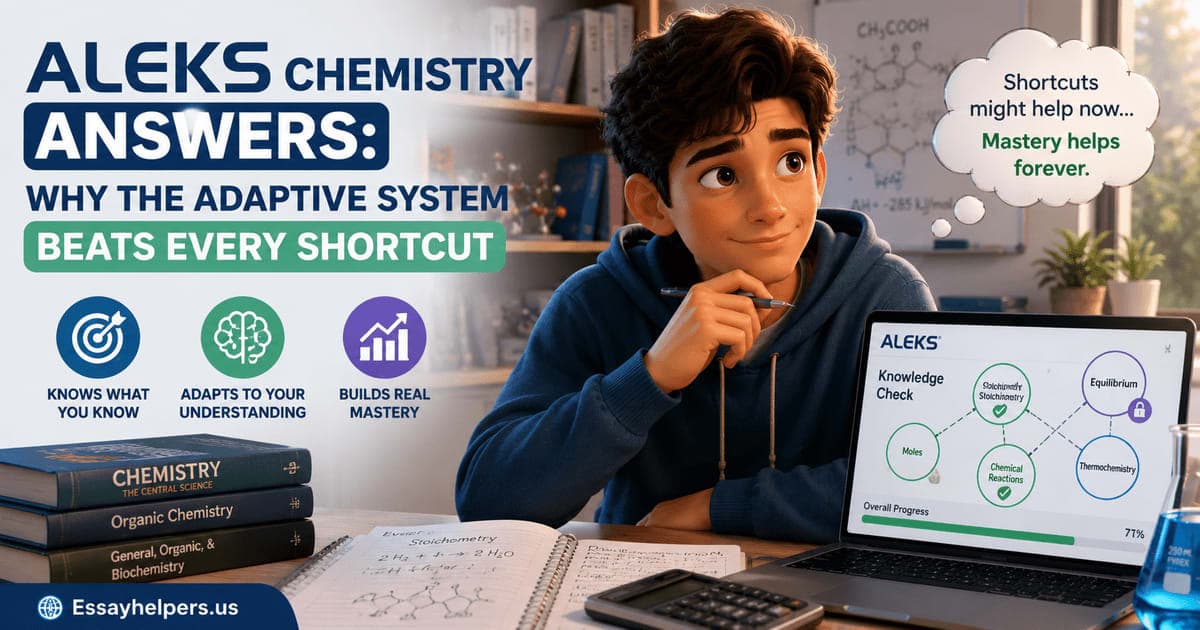
ALEKS chemistry answers: why the adaptive system beats every shortcut
Searching for ALEKS chemistry answers? Learn why shortcuts fail and what helps with stoichiometry and organic chemistry.
You're three weeks into your ALEKS chemistry course and you've just hit stoichiometry.
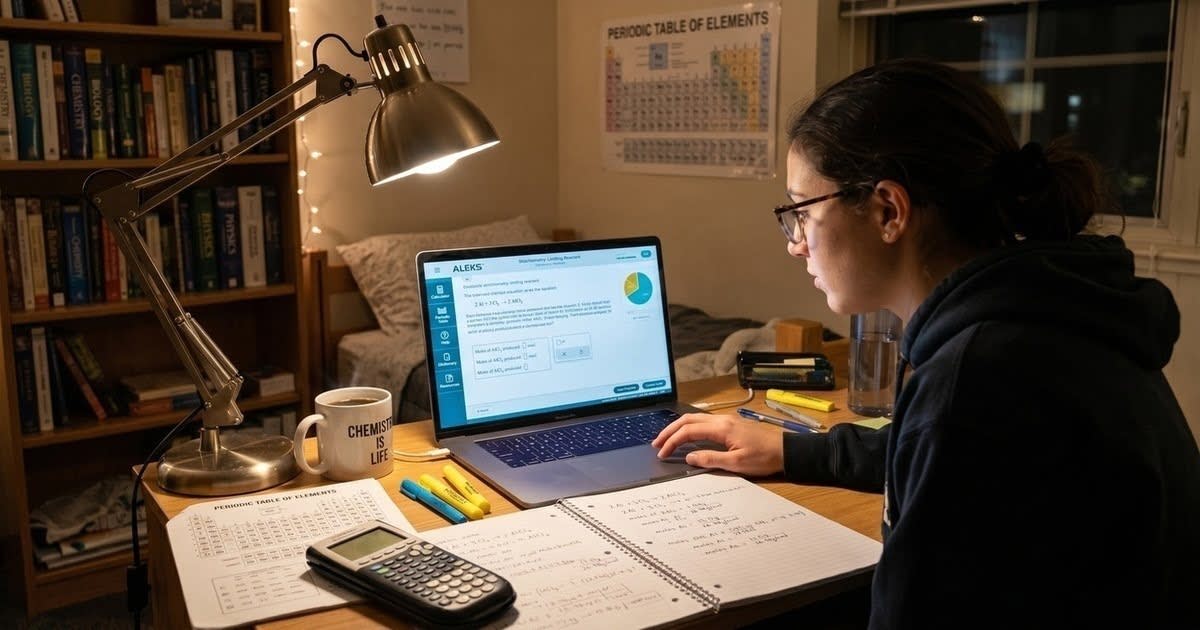
You've read the section twice. Watched two YouTube videos. Tried four practice problems and got three of them wrong. Your Knowledge Check is in 48 hours and your pie progress looks nothing like it needs to. Don't worry, your not the first in this situation, it more common than you might think.
So you do what most students do at that point. You search for ALEKS chemistry answers — an answer key, a forum post, anything that maps to the question in front of you.
What you find is a mix of forum threads, sites claiming to sell answer keys, and a few YouTube walkthroughs that are close to your topic but not quite right. You spend an hour going through them. Nothing maps to the questions in front of you.
That's not bad luck. That's how ALEKS chemistry is designed to work — and understanding that design is the first step toward actually getting through it. If you need help right now, the Essay Helpers team has subject specialists in chemistry who can work through your specific topics with you. But first, here's why the shortcut route keeps failing students.
For a more in-depth analysis of how Aleks Answers operate check out this blog post.
Why ALEKS chemistry is harder than other ALEKS subjects
Not all ALEKS subjects are equally difficult to navigate. Math courses — algebra, precalculus, statistics — have cleaner topic progressions and tend to build in more predictable sequences. Chemistry is different.
ALEKS chemistry draws from a broader and more interconnected topic pool. Concepts don't just build linearly — they loop back. Stoichiometry requires comfort with significant figures. Significant figures require comfort with scientific notation. Organic chemistry requires a foundation in bonding, which itself requires understanding electron configuration. If you're missing one layer, the next one won't hold.
That interconnectedness is what makes chemistry uniquely punishing on an adaptive platform. ALEKS isn't just tracking whether you got a question right. It's tracking whether your understanding across related topics is consistent. A gap in one area shows up as instability in several others.
Students who breeze through ALEKS math often hit a wall on chemistry. Why is ALEKS chemistry so hard compared to other subjects? The subject demands a different kind of preparation — broader, more relational, less about memorising formulas and more about understanding why the formulas work. That's not impossible to build. But it takes more than a few hours of searching for ALEKS chemistry answers online — and it's certainly not something you can shortcut by trying to hire someone to do ALEKS chemistry for you.
Enhance your Academic Performance And Reach Your Goals
See how quick and easy it is to get an exceptional essay with minimal effort on our platform
How many topics does ALEKS chemistry have — and why that number matters
Depending on the course your instructor has configured, an ALEKS chemistry course typically covers between 180 and 320 topics. General chemistry courses sit toward the lower end. Courses that include organic chemistry, lab calculations, or advanced problem-solving modules can push significantly higher.
For context, a standard ALEKS algebra course covers roughly 80–120 topics. Chemistry is two to three times that volume.
That scale changes the nature of the problem students face. Falling behind on ALEKS algebra by two weeks is recoverable with a focused effort over a few days. Falling behind on ALEKS chemistry by two weeks can mean 30–60 topics of deficit. At even a generous rate of five topics per study session, that's six to twelve sessions of catch-up before you're at a baseline that can pass a Knowledge Check.
This is why students turn to answer sources in the first place. The gap between where they are and where they need to be feels uncloseable in the time they have. The problem is that shortcuts don't close the gap — they hide it temporarily while making the next Knowledge Check harder.
The adaptive system explained: why your chemistry questions are never the same twice
ALEKS generates questions algorithmically, drawing from a large topic-specific database and adjusting to your current knowledge state. Two students in the same chemistry class, at the same point in the course, will receive meaningfully different questions — different compounds, different numerical values, different problem structures.
This is the detail that makes every "ALEKS chemistry answer key" site fundamentally useless.
A static answer key assumes fixed questions. ALEKS doesn't have fixed questions. Even if you found a site where a student had posted their stoichiometry problem and the correct solution, the numerical values in your version of that problem will be different. The working steps are the same. The answer is not.
What this means practically: the only thing that transfers between students is understanding. The method for solving a limiting reagent problem is the same regardless of which compounds ALEKS puts in front of you. A student who understands the method can solve any version of that problem. A student who copied an answer from a forum can only solve that exact version — and will fail the next one.
That's the core reason expert subject help outperforms answer hunting. A chemistry tutor isn't giving you the answer to one question. They're showing you the method that answers all of them.
The three chemistry topics where students lose the most ground on ALEKS
Based on the patterns that come up most consistently when students seek help with ALEKS chemistry, three topics cause the most sustained difficulty:
Stoichiometry. The conversion between mass, moles, and number of particles trips students up because it requires holding multiple unit relationships in mind simultaneously. ALEKS tests stoichiometry through variation — different starting units, different conversion chains, different target values. Students who learn stoichiometry by memorising worked examples can't adapt when the variables change.
Significant figures and scientific notation. This sounds like a basic topic. In practice, it becomes a persistent source of errors throughout the entire course because ALEKS embeds significant figure rules into almost every numerical answer. A student who gets the chemistry right but rounds incorrectly gets the question wrong. Repeated significant figure errors create a false picture of chemistry difficulty when the actual gap is narrower.
Organic chemistry functional groups. For courses that include organic content, this is where students who were managing adequately suddenly hit a wall. Functional group identification requires pattern recognition across hundreds of molecular structures. Flashcard-style memorisation helps to a point but breaks down when ALEKS presents unfamiliar molecule configurations built from familiar components.
Each of these topics has one thing in common: the path through them is conceptual, not memorisation-based. You can't find your way past stoichiometry by looking up answers. You find your way through it by understanding molar conversion well enough to apply it from any starting point.
Enhance your Academic Performance And Reach Your Goals
See how quick and easy it is to get an exceptional essay with minimal effort on our platform
Why ALEKS chemistry answer sites fail every time
There are a few different types of sites students find when searching for ALEKS chemistry answers. Understanding what each one actually offers helps explain why none of them work — and why searching for an ALEKS chemistry cheat consistently leads to the same dead ends.
Static PDF or question bank sites. These sell or post collections of chemistry problems with worked solutions. The problems are real chemistry — but they're not your chemistry questions. ALEKS generates your questions adaptively. The overlap between a downloaded problem set and your actual quiz is coincidental at best.
Forum threads with posted screenshots. Students occasionally post their ALEKS questions on Reddit or Chegg with the question visible. Sometimes another user answers it. Even when the answer is correct, it applies to that exact version of the question — specific compounds, specific numerical values. Your version has different values.
Live answer services. These are a different category — services where you submit your question and a person answers it in real time. Some of these deliver accurate chemistry answers. But they carry detection risk (see the timing and activity log patterns described in our companion post on whether ALEKS detects cheating), and they do nothing for the Knowledge Check that follows, where ALEKS asks you to demonstrate the same understanding independently.
Learning how to finish ALEKS requires professional guidance.
The consistent failure across all three categories isn't about service quality. It's about the structure of ALEKS itself. The platform is built to make copied answers non-transferable. That's a feature, not a bug.
ALEKS organic chemistry answers: why this module needs a different approach
Organic chemistry on ALEKS is worth addressing separately because students often underestimate how different it is from the inorganic chemistry content that precedes it.
General chemistry topics — stoichiometry, equilibrium, thermochemistry — are largely calculation-based. You learn a process, apply it to numbers, and get a numerical answer. Organic chemistry is identification and reaction-based. You look at a molecular structure and determine its functional group, its reactivity, or the product of a given reaction.
This shift from calculation to pattern recognition catches students off guard. The study strategies that worked for stoichiometry don't transfer directly. You can't solve an organic chemistry question by running through a formula. You need to have seen enough molecular structures to recognise the pattern in a new one.
What this means for ALEKS: searching for ALEKS organic chemistry answers is even less productive than searching for general ALEKS chemistry answers, because organic chemistry questions vary not just numerically but structurally. Two students may receive questions about ester functional groups, but the molecules drawn for each student will look different. The identifying features are the same — but you have to know what to look for.
Expert ALEKS chemistry homework help is particularly valuable here because organic chemistry is a subject where a good explanation from someone who knows the material accelerates recognition faster than any amount of solo practice with answer keys.
How expert chemistry help actually works — and what to look for
There's a meaningful difference between a service that does your ALEKS chemistry for you and one that helps you understand it well enough to do it yourself.
The first type gets your pie filled. The second type gets your pie filled in a way that holds up when ALEKS checks your understanding again in the next Knowledge Check — and when your professor runs a comparison of your assessed versus unassisted performance.
What good ALEKS chemistry help looks like in practice: a subject specialist who knows the specific topic you're stuck on, works through the concept with you using your actual question as the starting point, and explains the method rather than just the answer. After that session, you can solve variations of the same problem independently. That's the only outcome that actually helps you — not just this week, but through the rest of the course.
The Essay Helpers team works with students on exactly this basis. Contact us and we'll match you with a chemistry specialist who covers your specific ALEKS topic area — whether that's general chemistry, stoichiometry, organic chemistry, or the full course.
A testimonial account on the benefits of paying someone to do your ALEKS homework can be read here.
Want more topic updates?
Subscribe for new study resources, blog updates, and supporting cluster pages.
About the Author
Jonathan Avery
Ph.D. in Instructional Design, B.S. in Education